 Tmailor
 10 Best Temporary Email Providers: A Comprehensive 2026 Review
Dozens of temp mail services exist, and most look identical until an OTP fails to arrive. This review compares the 10 best temporary email providers of 2026 on the things that actually matter — retention, deliverability, reuse, API access, and privacy — and states the trade-offs plainly.
Quick access
Key Takeaways
The best temp mail provider is the one that matches your task — a quick throwaway inbox, a reusable private address, or an API for automated testing are three different jobs.
No single temporary email service wins every use case. This review ranks 10 providers for everyday private sign-ups and flags exactly which competitor is better for attachments, developer testing, or long-term retention. Tmailor publishes this list, so we rank ourselves first — the reasoning and the drawbacks are stated openly below.
- For reusable, private sign-ups via the web, Android and iOS apps, and a Telegram bot, we rank Tmailor first because it combines token-based address reuse, receive-only privacy, and a 500+ domain pool.
- For a fast, one-off inbox, Temp-Mail.org and 10 Minute Mail are the best-known options, though both keep messages for only a short time rather than archiving them.
- For developers, Mailinator and Mail.tm offer APIs; Mailinator's private domains and API are paid, while Mail.tm's REST API is free.
- For attachments and limited outbound-style workflows, Guerrilla Mail is the clearest outlier — most temp mail services, including Tmailor, are receive-only.
- For longer retention, YOPmail keeps mail about 8 days, but its inboxes are public and readable by anyone who knows the address — as are Mailinator and Maildrop.
- Temp mail suits low-stakes accounts; for banking, government, or healthcare, use a permanent inbox you control.
How We Researched and Ranked These Providers
We weighted retention, OTP deliverability, reuse, privacy model, platform coverage, and cost — not raw feature counts.
This is a source-verified comparison, not a lab benchmark. We checked each provider's official documentation, where available in July 2026, and drew on Tmailor's own product knowledge for its entry; we deliberately do not quote delivery rates or speed numbers we did not measure. Where a figure is volatile — pricing, retention windows, API terms — treat it as accurate at the time of writing and worth rechecking.
Each provider below was assessed on six criteria, in roughly this order of importance:
- Deliverability: Do verification codes actually arrive, and how often do sign-up forms refuse the provider's domains?
- Retention: How long do messages remain before being automatically deleted, and can you extend that window?
- Reuse: Can you reopen the same address later for a password reset, or is it a one-time, throwaway address?
- Privacy model: Are inboxes private to you, or public and readable by anyone who knows the address?
- Platform and access: web, mobile apps, a Telegram bot, or a documented API for automation?
- Cost and ads: genuinely free, ad-supported, or freemium with a meaningful paywall?
Feature lists matter less than whether the service reliably does the basic job — receiving a code before it expires. A provider that lists a dozen features but blocks on the first OTP is worse than a plain inbox that works.
A transparency note: Tmailor operates this blog, so ranking our own service first is inherently self-interested. Treat that placement with healthy skepticism. What we can do is state our limitations plainly and point out where each competitor genuinely does something better. For a second opinion focused on U.S. users, our no-hype review of U.S. temp mail services uses the same criteria. If you are still deciding whether the whole category fits your needs, start with whether a temporary email is safe for your situation.
Quick Comparison Table
Use this table to shortlist by job; the detailed reviews below explain the trade-offs behind each row. Details verified against provider sources in July 2026.
| Provider | Best for | Message retention | Privacy model | Reuse / API | Cost |
|---|---|---|---|---|---|
| Tmailor.com | Reusable private sign-ups | ~24 hours; address reusable via token | Private | Access Token reuse; no public API | Free |
| Temp-Mail.org | Quick throwaway inbox | Short-term; depends on mode/session | Session-based | API and premium features on paid tiers | Free with ads; premium |
| 10 Minute Mail | One-off short-lived inbox | 10 min, extendable | Session-based | No | Free |
| Guerrilla Mail | Attachments & limited outbound | ~1 hour | Public (address-based) | Choose/scramble address; can compose | Free |
| Mailinator | Developer & QA testing | Public inboxes, transient | Public | Public inboxes; private domains + API on paid plans | Free public; paid from ~/mo |
| Mail.tm | Free automation / API | 7 days; account valid until manually deleted | Private (account) | Free REST API (token auth) | Free |
| EmailOnDeck | Fast two-step sign-ups | Usually most of the day; session/cookie dependent | Session-based | API on Pro (crypto-paid) | Free; paid Pro |
| YOPmail | Longer retention | ~8 days | Public (no password) | Limited reply; no public API | Free |
| AdGuard Temp Mail | Users already in AdGuard's suite | 7 days inactivity; up to 6 months with regular use | Private/session-based | No public API | Free |
| Maildrop | Custom public inbox names, light dev use | Up to 10 messages; ~24h inactivity or sooner under load | Public | GraphQL API | Free |
The 10 Best Temp Mail Providers, Reviewed
Rankings are weighted for everyday private sign-ups; a "best for" note flags where each service is the stronger pick.
Our 2026 ranking at a glance:
- Tmailor.com
- Temp-Mail.org
- 10 Minute Mail
- Guerrilla Mail
- Mailinator
- Mail.tm
- EmailOnDeck
- YOPmail
- AdGuard Temp Mail
- Maildrop
1. Tmailor.com
Best for: reusable, private sign-ups you may need to log back into. We rank Tmailor first for that specific job because it pairs private, token-based reuse with a large domain pool — not because it wins on every metric. Tmailor is a free, no-registration temp mail service built on Google-MX infrastructure, with a 500+ domain pool and access via the web, Android and iOS apps, and a Telegram bot. Its defining feature is the Access Token: save it, and you can reopen the same address weeks later to catch a password reset, something most disposable services cannot do. If token-based reuse is the feature you care about, our guide to reusing a temp mail address walks through it.
Trade-offs: individual messages are deleted after about 24 hours, Tmailor is receive-only (it cannot send email), and it does not accept attachments or offer a public API. Where competitors beat it: Mailinator and Mail.tm for automated API testing, Guerrilla Mail for attachments and replies, and YOPmail for multi-day retention. Cost: free.
2. Temp-Mail.org
Best for: a quick, widely recognized throwaway inbox. Temp-Mail.org is one of the most established disposable email services, generating an address instantly with no sign-up required. It is a reasonable default for a single low-stakes verification.
Trade-offs: the free tier is ad-supported, retention is short-term rather than archival, and its premium features focus on custom or dedicated domains, multiple addresses, storage, and no ads. Because it is so widely used, some sites detect and refuse its domains. Our detailed Temp-Mail.org comparison covers where it fits and where it frustrates. Cost: free with ads; paid premium.
3. 10 Minute Mail
Best for: a genuinely one-off inbox you will never revisit. The address self-destructs after ten minutes, with a "give me 10 more minutes" button to extend as needed. It is about as simple as disposable email gets.
Trade-offs: the countdown is the whole design, so a code that takes several minutes to arrive can force an extension mid-signup, and there is no way to reopen the address later. For a side-by-side on which handles codes better, see temp mail vs. 10-minute mail for OTP. Cost: free.
4. Guerrilla Mail
Best for: the rare temp mail task that needs attachments or a limited outgoing/composition workflow. Guerrilla Mail is a long-running service that lets you receive files, compose messages, and scramble or choose your address.
Trade-offs: messages last only about an hour, the interface looks dated, and the receiving side frequently filters outbound mail from disposable domains, so the deliverability of anything you send is unreliable. Because an inbox is accessed by its address, with no password required, treat it as semi-public. Cost: free (donation-supported).
5. Mailinator
Best for: developers and QA teams testing sign-up flows. Mailinator's public inboxes accept mail at any @mailinator.com address instantly and pair well with automated test suites.
Trade-offs: public inboxes are exactly that — anyone can open an address and read it, so never use them for a real account. Private domains, private inboxes, and full API access require a paid plan starting at around per month, though verified QA professionals can access a free tier. Cost: free public; paid from about /month.
6. Mail.tm
Best for: free, scriptable automation. Mail.tm exposes a clean REST API with token authentication and stable domains, so it fits into CI/CD pipelines and automated tests without a paywall.
Trade-offs: it is aimed at developers rather than casual users; the web interface is basic; and while accounts stay valid until you delete them, messages are stored for 7 days. Cost: free.
7. EmailOnDeck
Best for: fast, privacy-minded one-off sign-ups. EmailOnDeck generates an address in a quick two-step flow, runs over HTTPS/TLS, and is hosted on SOC 2/PCI-DSS-certified infrastructure.
Trade-offs: the free inbox is session-dependent rather than durable — EmailOnDeck says it usually lasts most of the day and should last more than an hour, but access can be lost sooner if you close the browser or clear cookies. Advanced features (100+ addresses, custom domains, API) are available on a Pro plan paid only in cryptocurrency, and, like other well-known services, its domains are increasingly being detected and blocked. Cost: free; paid Pro.
8. YOPmail
Best for: when you need mail to stick around. YOPmail keeps messages roughly eight days — far longer than most disposable services — and offers several domains.
Trade-offs: its inboxes are public and password-free, meaning anyone who knows or guesses the address can read them, so they are unsuitable for anything sensitive. YOPmail supports limited reply behavior, but anonymous outbound sending is restricted, so treat it as a public temporary inbox rather than a full email account. The free experience also includes ads. Cost: free.
9. AdGuard Temp Mail
Best for: people already using AdGuard's privacy tools. It comes from a trusted privacy brand and integrates with AdGuard's tracker- and ad-blocking approach. Our explainer on what AdGuard temp mail is covers setup.
Trade-offs: AdGuard says an inbox is deleted after seven days if you do not open or refresh it, can last up to six months with regular use, and disappears immediately if you generate a new temporary address. There is no public API, and the service is most convenient inside the wider AdGuard ecosystem rather than as a standalone tool. Cost: free.
10. Maildrop
Best for: memorable custom inbox names and light developer use. Maildrop needs no sign-up, lets you pick your own inbox name, filters obvious spam, and exposes a GraphQL API for automated retrieval.
Trade-offs: Maildrop inboxes are public by design — anyone who knows or guesses the mailbox name can read its messages, and there is no login. Each inbox holds at most 10 messages, and inactive inboxes are cleared after about 24 hours, or sooner during heavy usage. Use it for low-risk testing, not private sign-ups. Cost: free.
How Temp Mail Changed in 2026
Three shifts separate today's best providers from the throwaway inboxes of a few years ago: blocking, APIs, and the public-versus-private divide.
First, detection has tightened. Popular disposable domains are now the most frequently rejected, so the services that hold up are the ones with large, rotating domain pools rather than a single well-known domain. Second, developer demand pushed several providers toward documented APIs; Mail.tm's free REST API and Mailinator's paid API turned temp mail into a testing tool that plugs into CI/CD pipelines, not just a web page. Third, the old public-inbox model — where any visitor can read a known address, as on Mailinator and YOPmail — increasingly reads as a privacy liability, nudging privacy-focused users toward private, token-based inboxes. The practical takeaway is that "best" now depends more on reliability and privacy model than on a long feature list.
How to Choose the Right Temp Mail Service
Match the provider to the task: reuse, retention, developer access, or a specific alternative. Each point corresponds to a different pick.
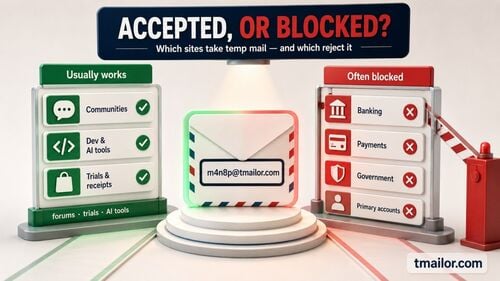
If you are comparing the best temporary email service for a specific job, start from the risk, not the feature list: private account recovery, one-off verification, developer testing, and public throwaway inboxes each need a different tool. If you need the address again, choose a service with token-based reuse rather than a countdown timer. If you are automating tests, choose one with a documented API. If a site rejects disposable domains, the fix is usually a different domain, not a different tactic — our reference on sites that block temp mail explains which services are most likely to be filtered.
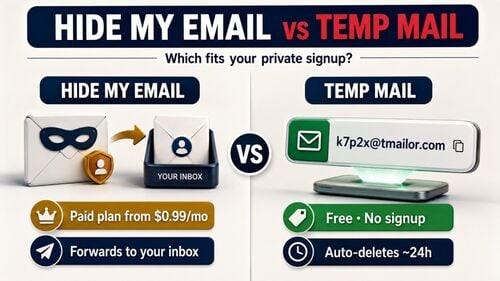
Temp mail is also not the only privacy tool. Email aliases and forwarding services solve a different problem, and it helps to understand how disposable, burner, and temp mail differ before picking one. For a task-by-task shortlist, our guide to temp mail alternatives by need maps tools to jobs, and if you want to weigh non-temp options, see alternatives to temporary email and the practical comparison of Apple Hide My Email versus temp mail.
Honest Limitations of Every Temp Mail Service
No provider on this list is a fit for high-stakes accounts, and several share the same structural limits.
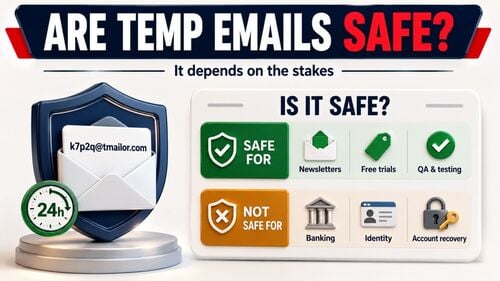
Every service here is designed for low-stakes, disposable use. None is appropriate for banking, government portals, healthcare, or any account where losing inbox access carries real consequences — use a permanent mailbox you control for those. Public-inbox services such as Mailinator, YOPmail, and Maildrop add a further caveat: because anyone can read a known address, they should never hold a private code you care about.
Two more shared limits are worth stating. First, no temp mail provider can guarantee that a verification code will arrive because the sending platform decides whether to deliver to a disposable domain. Second, retention is short by design across the category; treat any code or link as something to use immediately, not to store.
Frequently Asked Questions
What is the best temp mail provider in 2026?
There is no single best provider for everyone. For reusable private sign-ups, Tmailor leads on token-based reuse and a large domain pool; for developer testing, Mailinator or Mail.tm offers APIs; for attachments, Guerrilla Mail is the outlier; and for longer retention, YOPmail keeps mail for about 8 days. Match the service to the task rather than chasing feature counts.
What is the best temp mail service in 2026?
The best temp mail service in 2026 depends on the job at hand. Choose Tmailor for reusable private sign-ups, Mail.tm for free API testing, Guerrilla Mail for attachments or limited outbound workflows, YOPmail for longer public retention, and 10 Minute Mail for one-off short-lived inboxes. There is no single winner across every use case.
Which temp mail service keeps emails the longest?
Among the providers here, YOPmail keeps messages for the longest, roughly 8 days, and AdGuard can hold an inbox for up to 6 months with regular use. Tmailor and Maildrop fall in the day range, while 10 Minute Mail, Temp-Mail.org's free tier, and EmailOnDeck are short-term and session-based. Longer retention often comes with a privacy trade-off, since YOPmail's inboxes are public.
Which temp mail providers offer an API?
Mail.tm offers a free REST API with token authentication, and Maildrop exposes a GraphQL API. Mailinator provides an API on its paid plans, and EmailOnDeck includes API access in its crypto-paid Pro tier. Tmailor and most consumer-focused services do not publish a public API, since they are built for manual sign-ups rather than automation.
Are free temp mail services safe to use?
They are reasonable for low-stakes sign-ups but not for sensitive accounts. Public-inbox services like Mailinator, YOPmail, and Maildrop can be read by anyone who knows the address, and any disposable inbox is short-lived by design. Never use temp mail for banking, government, or healthcare accounts, and read a provider's privacy policy before relying on it.
Can I reuse a temporary email address later?
Only if the provider supports it. Most disposable services generate a throwaway address that disappears, but token-based services let you reopen the same inbox later with a saved key. This matters if you may need a future password reset, since a reusable address can receive the reset code while a timer-based inbox cannot.
Why do some sites reject temp mail addresses?
Some services maintain blocklists of known disposable domains, and the most popular temp mail domains are the most frequently blocked. Switching to a different domain from a provider with a large pool often resolves it, but acceptance is never guaranteed. For important accounts you plan to keep, a permanent email is the safer choice.
What is the best free temp mail service without ads?
Several providers here are free and don't have an ad-heavy interface, including Tmailor, Mail.tm, and Maildrop. Temp-Mail.org and YOPmail are free but ad-supported. If a clean, ad-light experience matters, favor a provider whose free tier is the main product rather than a funnel to a paid upgrade.
Is using a temporary email address legal?
Using temp mail to protect your privacy during sign-up is legal in most places and a common way to reduce spam. What can violate a service's terms is how you use it — creating fake identities, spamming, or mass-producing accounts. Keep temp mail for legitimate, single-account privacy, and check the site's terms before joining.
Do temp mail providers keep logs of my activity?
Policies vary by provider, so read the privacy policy before relying on one. Many disposable services minimize stored data and automatically purge inbox content, but retention windows, IP logging, and ad network behavior differ. Providers that require no registration and delete messages on a short schedule generally hold less about you than ad-funded services.
Can temp mail providers send email, not just receive it?
Most are receive-only by design, including Tmailor. Guerrilla Mail is the clearest exception for limited outgoing and composition workflows, while YOPmail supports limited reply behavior inside its own model. Mail from disposable domains is often filtered by the recipient, so for dependable outbound email, use a standard mailbox.
The Bottom Line
The right temp mail provider depends on the job; this list gives you a defensible starting point for each one.
Temporary email in 2026 is a mature category, and the ten services here cover a realistic range of needs: quick throwaways, reusable private inboxes, developer APIs, attachments, and longer retention periods. We rank Tmailor first for reusable, cross-platform private sign-ups and have named the exact cases where Mailinator, Mail.tm, Guerrilla Mail, and YOPmail are better tools. When you are ready to try one, you can create a free temp mail inbox and judge it against this list yourself.

Minh Nguyen is the founder of Tmailor and the developer who publishes the Tmailor temp mail apps on the App Store and Google Play. He has built and operated Tmailor's free, receive-only disposable email service since 2022, focusing on reliable OTP delivery, inbox privacy, and reusable temp mail addresses.