Temp Mail vs Email Aliases: SimpleLogin, Firefox Relay, and addy.io Compared
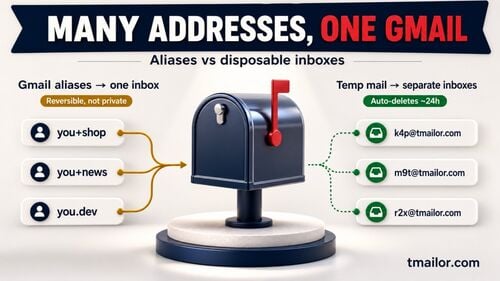
Temp mail and email aliases both hide your real address, but they serve different purposes. This comparison comes down to how long the relationship lasts — a forwarding alias for the long haul, or a disposable inbox for a code you will never revisit.
Quick access
Key Takeaways
An alias forwards mail to you for the long haul; temp mail catches a code and disappears — pick by how long you need it.
Temp mail vs email aliases is a lifespan decision: an alias keeps receiving and can reply over time, while temp mail is a receive-only inbox for a one-off code. This article compares receive-only temp mail with forwarding alias services as a category, using SimpleLogin, Firefox Relay, and addy.io as examples.
- Email aliases forward to your real inbox and can reply, so they suit accounts you keep long-term while hiding your true address.
- Temp mail, like Tmailor, is receive-only and disposable, so it suits one-off signups, OTP codes, and content gates you will never revisit.
- Free tiers vary widely: SimpleLogin includes replies free, addy.io's free plan is capped at 10 MB of monthly bandwidth, and Firefox Relay Free gives five masks. Temp mail needs no account at all.
- If a site must reach you later — order updates or a password reset you rely on — use an alias; if you need a code once, use temp mail.
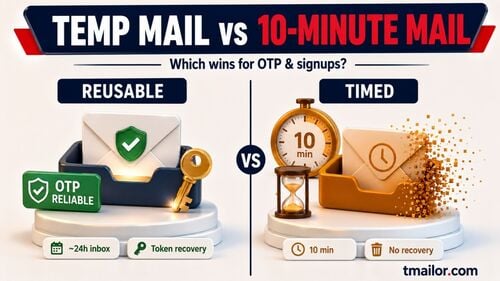
- Tmailor adds an Access Token so you can reopen the same temp address later, but it only bridges the address-reuse gap, not forwarding or replying.
- Neither hides you from the service you sign up with, and both can be blocked by sites that screen masked or disposable domains.
Temp Mail vs Email Aliases: The Short Answer
Choose by the lifespan of the relationship, not the brand.
Choose an email alias when you want a masked address that forwards to your real inbox and can reply for months or years — a store account or a service that emails you back. Choose temp mail when you need a throwaway inbox to catch a verification code once and never return. Aliases are for continuity; temp mail is for disposal. Put another way, email alias vs temp mail and alias forwarding vs temp mail both come down to continuity vs disposal.
The decision trigger is one question: Will the service need to reach me again? If yes, a forwarding alias keeps that channel open. If no, a disposable inbox is faster and leaves no forwarding rule or alias to manage. When you want disposability but might come back once, reuse the same temp address. An Access Token sits between the two, though it only reopens the address — it does not forward mail.
How Email Aliases Work (SimpleLogin, Firefox Relay, addy.io)
An alias is a forwarding address that hides your real one while keeping mail flowing to you.
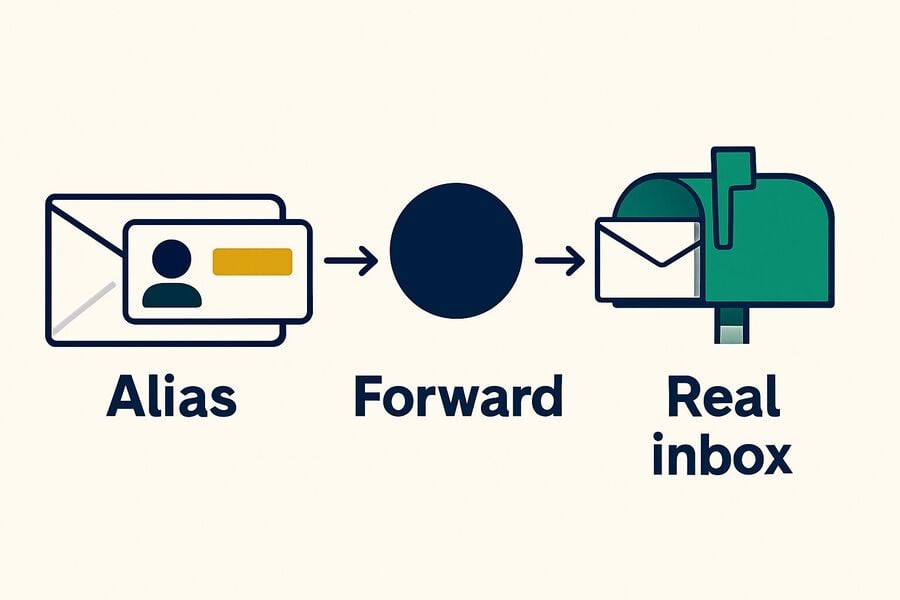
An email alias is a forwarding address that receives mail and relays it to your real inbox, so the sender never sees your true address. Tier details vary: SimpleLogin Free includes replies; Firefox Relay Premium adds replies and a mozmail.com Relay subdomain; addy.io paid tiers add bandwidth, custom domains, and reply or send. Aliases persist with the account.
SimpleLogin, a Proton product, gives a free plan with 10 aliases, unlimited bandwidth, one mailbox, and — notably — replies from the alias included at no cost. Its Premium tier adds unlimited aliases, custom domains, and the ability to initiate a brand-new email to a new contact via a reverse alias. That makes the free-versus-paid line about volume and outbound, not about basic replies.
Firefox Relay, from Mozilla, offers 5 free email masks. Relay Premium adds unlimited masks, a custom subdomain under mozmail.com, and anonymous replies — Mozilla says Premium users can reply to a forwarded email within 3 months of receiving it. Relay's phone masking sits in a separate "Email & phone" tier, and Relay Premium itself is available only in the countries Mozilla lists on its official site.
addy.io offers a free plan with unlimited standard aliases, 10 active shared-domain aliases, one recipient, and 10 MB of monthly bandwidth — the bandwidth cap is the free tier's real constraint. Paid Lite and Pro tiers raise bandwidth, add custom domains, and enable paid replies and sends. Across all three services, the common thread is this: an account is required, mail forwards to a real inbox, replying or sending is often tier-gated, and the alias lasts as long as the account under each provider's acceptable-use policy.
How Temp Mail Works (and Where Tmailor Sits)
Temp mail is an instant, no-signup inbox that receives — and then forgets.
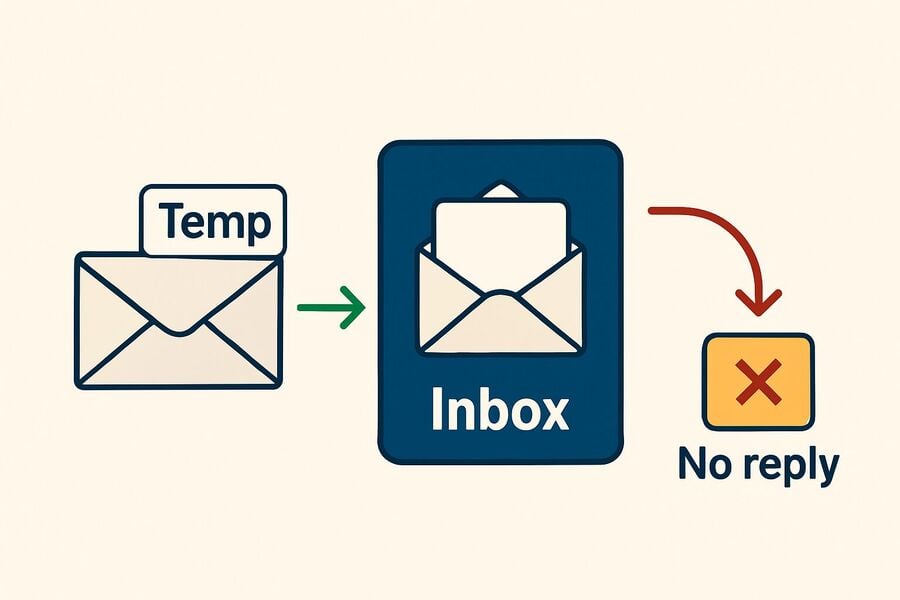
Temp mail is a disposable inbox you can open without registering, used to receive a verification email or a one-off message, then abandon. Messages auto-delete after a set window — about 24 hours on Tmailor — and there is no forwarding to a personal inbox. Tmailor adds an Access Token so you can reopen the same address later across the web, the app, and the Telegram bot.
The defining difference from an alias is simple: temp mail has no forwarding and no reply. Can you reply from a temporary email? No — replying to a message requires an alias or forwarding service, not a disposable inbox. Tmailor is receive-only by design, with 500+ domains, Google MX for inbound delivery, and no attachments. Its Access Token is a private recovery key that reopens the same address, and a lost Access Token cannot be recovered, so it is a convenience for reuse rather than an account you log into.
Tmailor publishes this comparison, and its plan details for the alias services here were checked on July 13, 2026. To go deeper on when a reusable inbox beats a throwaway, see our guide to reusable vs short-life inboxes. New to the terminology altogether? Our primer on disposable, burner and temp mail untangles the labels.
Full Comparison Table
Nine dimensions that decide alias versus temp mail. Verified against provider pages on July 13, 2026.
On the dimensions that matter — forwarding, replies, longevity, registration, and cost — aliases and temp mail split cleanly. Aliases forward and can reply, depending on the tier, but need an account; temp mail is instant and free, but receive-only and short-lived. The table maps each service so you can shortlist by the job, not the brand.
| Dimension | Temp Mail (Tmailor) | SimpleLogin | Firefox Relay | addy.io |
|---|---|---|---|---|
| Forwards to your real inbox | No | Yes | Yes | Yes |
| Reply from the address | No | Yes (incl. Free) | Yes (Premium) | Yes (paid) |
| Send to a new contact | No | Yes (paid reverse alias) | Reply to forwarded email only (Premium) | Yes (paid) |
| Registration required | No | Yes | Yes (Firefox account) | Yes |
| Free tier | Fully free | 10 aliases, replies free | 5 masks | Unlimited standard aliases; 10 active shared-domain aliases; 1 recipient; 10 MB/mo |
| Longevity | ~24h messages; address reusable via Access Token | As long as the account | As long as the account | As long as the account |
| Custom domain | Separate custom-domain page | Premium | Relay subdomain (mozmail.com); Premium only | Paid |
| Best job | One-off signups, OTP | Long-term masked accounts | Casual masking in Firefox | Open-source alias management |
| Cost | Free | Free + paid | Free + premium | Free + paid |
When an Email Alias Is the Better Choice
If the account must be able to reach you back, an alias wins.
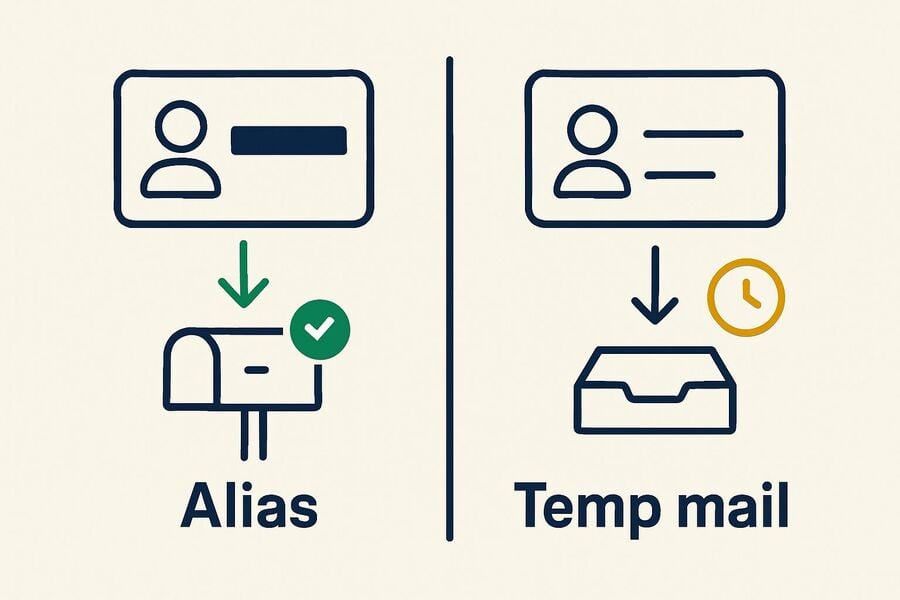
An email alias is the better choice when a service needs to contact you over time — order confirmations, shipping updates, or password resets you rely on. Because an alias forwards to your real inbox and can be replied to, you stay reachable while hiding your true address. Temp mail's auto-expiry would lose those messages, which is why aliases suit accounts you keep, including anything tied to email alias password resets.
Concrete cases favor an alias: an online store you reorder from, a SaaS subscription you renew, or a community forum you post in every month. In each, you want mail to keep arriving without exposing your primary address. A useful test is whether losing a future message would cost you something — a missed shipping update, a delayed invoice, or a password reset you cannot complete. If the answer is yes, the forwarding and reply that an alias provides are worth the small overhead of managing it. If you are already in Apple's ecosystem, our look at Apple Hide My Email covers that specific relay; for browser-level masking with tracker removal, see DuckDuckGo email protection.
When Temp Mail Is the Better Choice
If you only need a code and never want to hear from them again, temp mail is faster and free.
Temp mail is the better choice for low-stakes, one-time signups: a content gate, a coupon, a one-off download form, or a forum you will read once. You get an inbox in seconds with no account, catch the verification code, and let it expire — no alias list to manage and nothing forwarding to your real inbox. Tmailor's Access Token covers the rare case where you might return to the same address.
The appeal is disposability: content gates, coupons, and one-off download forms are exactly the moments you do not want tied to a permanent identity. To match a disposable inbox to a specific task, our guide to the best temp mail by need lays out which option is best for each job.
There is also a speed and hygiene argument. An alias adds a small amount of management — you create a mask, it joins your account list, and it forwards until you disable it. For a signup you know is single-use, that overhead buys nothing. Temp mail skips it entirely: open an inbox, read the code, and walk away with no list to prune and no forwarding rule left running. Over dozens of throwaway signups a year, keeping those out of your alias account also keeps that account tidy, so the two tools reinforce each other rather than compete — aliases for the handful of relationships you keep, temp mail for the long tail you do not.
Limitations Both Share
Masking your address is not the same as being invisible to the service.
Neither an alias nor temp mail makes you anonymous to the service itself — you still hand over whatever the signup form requires. Both approaches also share real constraints worth knowing before you rely on them.
- Sites can block both masked-alias and disposable domains, so a verification code is never guaranteed to arrive — and yes, email aliases can be blocked much like temp mail.
- Aliases centralize risk, because one account gates every mask; temp mail loses messages on expiry.
- Neither is a safe home for anything sensitive you must retrieve later; treat both as privacy layers, not storage.
- For banking, government, or healthcare accounts, use a permanent inbox you fully control. Our overview of whether a temporary email is safe clarifies where the line is drawn.
Frequently Asked Questions
Is an email alias the same as temp mail?
No. An email alias forwards mail to your real inbox and can usually reply, so it works for long-term accounts you keep. Temp mail is a disposable, receive-only inbox that auto-deletes messages and forwards nothing, so it is ideal for one-off signups and verification codes you will never revisit.
Disposable email vs email alias: are they the same?
No. Disposable email is a throwaway, receive-only inbox that expires after a short window. An email alias is a forwarding address tied to your account that relays mail to your real inbox for as long as you keep it. Disposable email is for one-off use; an alias is for ongoing masked mail.
SimpleLogin vs temp mail: which is better?
It depends on the job. SimpleLogin is better for masked accounts you keep, since its free plan includes replies and forwards to your real inbox. Temp mail is better for a one-off code you never need again, because it needs no account and leaves no alias to manage.
Can I reply from a temp mail address?
No. Tmailor and most temp mail services are receive-only, so you cannot reply. Replying requires an alias or forwarding service — SimpleLogin includes replies on its free plan, while Firefox Relay and addy.io enable them on paid tiers.
Firefox Relay vs disposable email: which should I use?
Use Firefox Relay for ongoing forwarding and Premium replies within three months of a message. Use a disposable or temp email for one-off, receive-only signups you never return to. Relay Free gives five masks; Premium adds unlimited masks and a mozmail.com Relay subdomain.
Is Temp Mail an addy.io alternative?
Only for one-off, receive-only signups. Temp mail does not forward to your inbox, reply, or support custom domains and long-term account mail, which are the core reasons to use addy.io. For a one-time code, temp mail is simpler; for durable masked forwarding, addy.io is a better fit.
Email masking vs temporary email: what is the difference?
Email masking forwards mail to your inbox and persists with your account, so you keep receiving messages while your address is hidden. A temporary email is a throwaway inbox that receives messages once and then expires. Masking is for continuity; a temporary email is for disposal.
Can I use temp mail for accounts I keep?
Usually no. Use an alias if the account must reach you later. Tmailor's Access Token only reopens the same address; it does not forward mail, enable replies, or preserve messages beyond the retention window, so it is not a substitute for a forwarding alias on long-term accounts.
Do aliases and temp mail get blocked?
Sometimes. Some sites screen both masked-forwarding domains and disposable domains during signup. If a site rejects a masked or temporary address, use a permanent inbox you fully control for that account, especially when future access matters.
The Bottom Line
The choice is not between temp mail and aliases in the abstract — it is about how long the relationship lasts. Use SimpleLogin, Firefox Relay, or addy.io when you want a masked address that forwards and replies for the long term; use temp mail when you need a throwaway inbox for a code you will never revisit. When you want disposability but might return, Tmailor's Access Token bridges the address-reuse gap — and when you need an inbox now, you can create a free temp mail in seconds.

Elena Petrova compares temp mail and burner email services head to head. She reviews providers, weighs Tmailor against alternatives like 10 Minute Mail, Guerrilla Mail and Apple Hide My Email, and explains which option fits which use case.