How Long Does Temp Mail Last? Message Retention and Address Lifespan Explained
How long does temp mail last? Most messages last from minutes to a few days, while the address may expire with the session or reopen later if the service supports reuse. This guide compares message retention and address lifespan across major services in 2026.
Quick access
Key Takeaways
Temp mail has two clocks — one for the messages, one for the address — and they rarely match.
How long temp mail lasts depends on the service and on which clock you mean. Message retention decides how long emails stay; the address model decides whether you can come back. Confusing the two is why people expect a throwaway inbox to last longer than it does.
- Most temp mail messages auto-delete within minutes to a few days; on Tmailor, they clear after about 24 hours.
- The address can outlive its messages: some services keep the name alive or let you return to it, and Tmailor's Access Token reopens the same address.
- Short-timer services like 10 Minute Mail delete quickly; longer-window services like YOPmail (8 days) and AdGuard (up to 6 months with use) keep mail longer.
- You can't rely on temp mail to store anything — copy any code or link you need before the window closes.
- A lost Tmailor Access Token can't be recovered, so a reusable address is only as durable as the Access Token you keep.
- A "permanent" public address name, as on YOPmail or public Mailinator, is not private — anyone who knows it can read it.
How Long Does Temp Mail Last? Short Answer
Minutes to a few days for messages; the address can persist if the service allows reuse.
How long temp mail lasts depends on the service and on which clock you mean. Most temp mail messages auto-delete within minutes to a few days — about 24 hours on Tmailor — while the address itself may last one session or, on services that support it, far longer. Tmailor keeps messages for roughly 24 hours, but lets you reopen the same address later if you saved the Access Token.
So temp mail expiration is really two questions, and the temporary email lifespan you care about depends on which one you mean. If you only need to read a verification code, message retention is what matters. If you plan to use the address again, the address model matters more — and you can reopen the same address on services built for reuse.
Two Different Lifespans: Messages vs the Address
Retention deletes your mail; the address model decides whether you can come back.
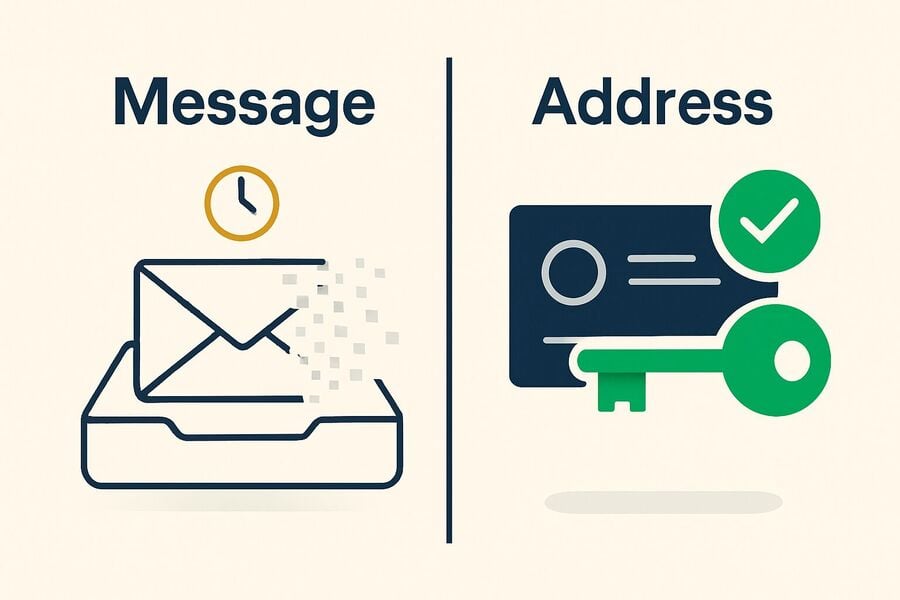
Temp mail has two separate lifespans. Message retention is how long a received email stays before automatic deletion — often minutes to a couple of days. The address access model determines whether you can return: a pure throwaway dies with the session; a public service keeps the name alive permanently; and a reusable service like Tmailor reopens the address through an Access Token even after its messages have cleared.
They differ because they serve different goals. Retention protects privacy and saves storage, so services delete messages quickly. The address model serves continuity, so some providers keep the name reachable or hand you a recovery key. On Tmailor, a message is gone at about 24 hours, but the address returns via the Access Token. For a deeper look at that trade-off, see our guide to reusable vs short-life inboxes.
How Long Each Temp Mail Service Lasts (2026)
A service-by-service look at both clocks. Verified against provider pages on July 13, 2026.
Temp mail lifespans vary widely in 2026. Tmailor keeps messages for about 24 hours with a reusable address; 10 Minute Mail starts at about 10 minutes with a resettable timer; Temp-Mail.io stores messages for 1 day on free and 30 days on premium; AdGuard can hold an inbox for up to 6 months with regular use; and YOPmail keeps mail for 8 days on a public, unprotected address. Always confirm the current window before relying on it.
Disclosure: Tmailor runs this blog, and Tmailor is included in the comparison below. This is a first-party comparison of published provider information, not an independent lab test. Tmailor's limits matter here too: it is receive-only, inbox messages stay visible for about 24 hours, deleted messages cannot be recovered, and a lost Access Token cannot be restored.
| Service | Message retention | Address access / reuse model | Notes |
|---|---|---|---|
| Tmailor | ~24 hours | Reusable via Access Token | Receive-only; no attachments; lost Access Token unrecoverable |
| 10 Minute Mail | ~10 min (timer resets on "10 more minutes") | Session/timer | No official maximum extension (unverified) |
| Temp-Mail.org | Not clearly published on the official page checked July 13, 2026 | Address valid until deletion or domain-list change | Premium advertises custom domains, up to 10 addresses, and extended 100MB storage |
| Temp-Mail.io | 1 day free; 30 days premium (regular mode) | Active while open; available for several hours after; reactivatable from history | 10-minute mode is separate |
| Guerrilla Mail | 60 minutes | Address never expires; scrambled address is a privacy feature | Session ~18 min inactive; extend max 2 hours |
| YOPmail | ~8 days | Permanent public name (never deleted) | Public inbox — anyone with the name can read it |
| AdGuard Temp Mail | 7 days without opening; up to 6 months with use | Deleted immediately when a new address is generated | Unrecoverable once deleted |
| Mailinator | Several hours (public) | Public inbox name; paid/private storage lasts longer | Do not use for secrets |
Two patterns stand out. Free tiers tend to be shorter, and premium plans extend retention. A paid window is often the difference between one hour and a month. Public-name services such as YOPmail and Mailinator trade privacy for convenience: the inbox name can be reused, but message retention is still limited, and anyone who knows the name can read the mail. For a closer comparison of the shortest windows, see temp mail vs 10 minute mail.
How to Keep a Temp Mail Address Longer
You can't stop auto-deletion, but you can keep the address and save what matters in time.
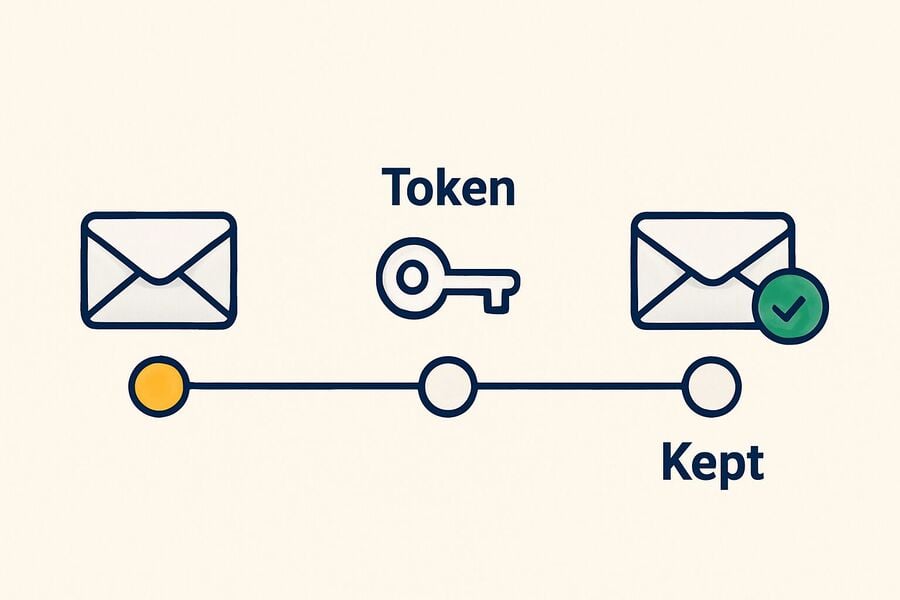
You cannot pause a service's auto-deletion. Still, you can extend its usefulness in three ways: pick a service that lets you reuse the address, act within the retention window to copy any code or link you need, and store nothing sensitive that you'd need to retrieve later. The address can persist even when the messages don't, which is the key to how long you can keep a temp mail address.
Use a reusable service and save the Access Token.
On a reusable service like Tmailor, save the Access Token, and you can reopen the same address later — but keep the Access Token safe, because a lost Access Token cannot be recovered.
Read and act before the window closes.
Retention is the deadline. Copy a verification code or click a link while the message is live, since it will be gone once the window passes.
Don't treat temp mail as storage.
A disposable inbox is not an archive. If you need to keep a message, move it out promptly; our note on back up a temp inbox covers the options.
When a Short Lifespan Is a Problem (and What to Use Instead)
If you need mail to stick around, temp mail is the wrong tool.
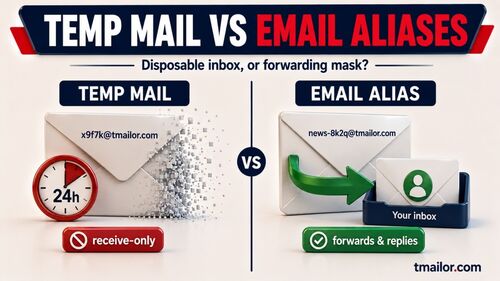
A short lifespan becomes a problem when a service emails you later — shipping updates, delayed OTPs, or password resets you rely on. Because temp mail auto-deletes and pure throwaways can't be reopened, those messages are lost. For anything you must keep, use a reusable temp address, an email alias that forwards to your inbox, or a permanent mailbox you control.
Each alternative fits a different need: a reusable temp address suits an account you revisit occasionally, a forwarding alias suits ongoing mail you want masked, and a permanent inbox suits anything important. Our overview of temp mail limits and risks explains where a disposable inbox should not be used.
Frequently Asked Questions
How long do temp mail messages stay?
Most temp mail messages auto-delete within minutes to a few days; on Tmailor, messages clear after about 24 hours. The address can outlast the messages, so the retention window and the address lifespan are two separate clocks.
How long does a temp email last?
A temp email lasts from minutes to a few days, depending on the service — about 24 hours on Tmailor — while the address can last longer if the service supports reuse.
Do temp emails expire?
Yes: the messages auto-delete on a fixed window, even when the address itself remains reachable.
Do temp mail addresses expire?
It depends on the address model. Session and timer throwaways expire quickly; public services keep the name alive permanently; and reusable services like Tmailor reopen the address via an Access Token even after the messages are gone.
Can I get a temp email back after it expires?
You can reopen a reusable address if you saved its Access Token or history entry. A lost Tmailor Access Token cannot be recovered, and expired messages are gone for good, so save anything important before the retention window closes.
How long does a 10-minute mail last?
A 10-minute mail address starts around 10 minutes, and the "10 more minutes" button resets the countdown. No official maximum extension is published, so treat the window as short and copy any code as soon as it arrives.
Which temp mail lasts the longest?
It depends on the criterion. AdGuard can last up to 6 months with regular use; Temp-Mail.io premium keeps messages for 30 days and lets premium users save important messages permanently; YOPmail holds mail for 8 days, but on a public address; and public Mailinator messages last only several hours. There is no single winner.
Does Temp Mail delete emails?
Yes. Every temp mail service auto-deletes messages after its retention window; on Tmailor, that is about 24 hours. The reusable address remains available afterward, but deleted messages cannot be recovered.
Can I stop Temp Mail from deleting messages?
No. Auto-deletion is built in and cannot be turned off. Copy anything you need within the window, and use a permanent, controlled inbox for mail you must keep long-term.
The Bottom Line
Temp mail rarely lasts as long as people expect — most messages clear within minutes to a couple of days, and Tmailor's is about 24 hours. The address, though, can outlast the mail: a reusable service lets you return to the same inbox long after its messages are gone. Match the window to the task, never treat a disposable inbox as storage, and when you need one now, create a free temp mail in seconds.

Marcus Lee writes Tmailor's step-by-step guides — signing up to apps and platforms with temp mail, using the mobile app and Telegram bot, custom domains, reusing addresses, and getting the most out of disposable email day to day.