Temp Mail for Crypto Exchanges & Wallets: When It's Safe and When It's a Trap
In crypto, your email address isn't just a login — it's the master key to password resets, OTP codes, withdrawal confirmations, and KYC identity links. Use the wrong email address, and you could permanently lose access to funds. This guide breaks down exactly when a temporary email protects your privacy on exchanges, airdrops, and DeFi tools — and when it quietly becomes a single point of failure that no support team can fix. You'll get a clear risk framework for matching the right email type (permanent, reusable temp, or burner) to every crypto platform you use.
Quick access
Short answer: a temporary email is fine on the edges of crypto — newsletters, airdrops, waitlists, testnet tools — and a bad idea for anything that holds money. On a KYC'd exchange or a custodial wallet, your email is the master key to password resets, withdrawal confirmations, and account recovery. If losing that inbox could lock you out of funds or an identity check, use a permanent address you control, not a disposable one that may quietly disappear.
If you are new to disposable inboxes, start with the overview of how temporary email works, then come back and map those behaviors onto your crypto stack.
TL;DR
- Treat your email address as a master recovery key for exchanges and custodial wallets; losing it can mean losing funds.
- A temporary email is fine for low-stakes crypto use, such as newsletters, testnet tools, research dashboards, and noisy airdrops.
- Never use short-lived temporary email addresses for KYC'd exchanges, primary wallets, tax dashboards, or anything that must function years later.
- Reusable, token-protected inboxes can work for medium-risk tools only if you save the Access Token and accept that messages age out after about 24 hours.
- OTP delivery depends on the exact address, the platform's own policy, and inbox timing — not on hammering resend or cycling through domains.
- Build a three-layer setup: a permanent "vault" email, a reusable temporary email for experiments, and burners for pure throwaways.
Understand Crypto Email Risk
Your email address quietly connects logins, withdrawals, and support decisions across almost every crypto platform you touch.
Email as the root recovery key
On centralized exchanges and custodial wallets, your email is more than a field you type on the sign-up screen. It is where:
- Sign-up confirmations and activation links are delivered.
- Password reset links and device-approval prompts arrive.
- Withdrawal confirmations and unusual-activity alerts are sent.
- Support agents verify whether you still have access to the account's contact channel.
If that mailbox disappears, is wiped, or was never entirely under your control, every one of those flows becomes fragile. Even when a platform allows manual recovery with ID documents, the process can be slow, stressful, and uncertain.
What actually breaks when email fails?
When you pair high-value crypto accounts with unstable email, several things can go wrong:
- You cannot confirm new devices or locations, so login attempts continue to fail.
- Password reset links arrive in an inbox that you can no longer access.
- Security alerts about forced resets or suspicious withdrawals never reach you.
- Support sees transient contact data and treats your case as higher risk.
The practical rule is simple: if an account can hold meaningful money for years, its recovery email should be boring, stable, and entirely under your control.
How temp mail behaves differently
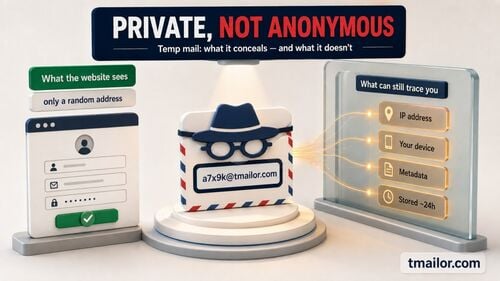
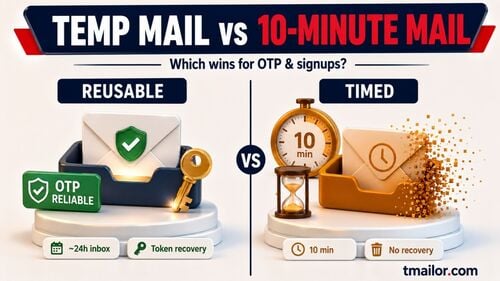
Temporary email services are built for short-lived or semi-anonymous identities. Some addresses are pure single-use burners. Others, like the reusable model on tmailor.com, let you reopen the same inbox later with an Access Token — but note what that token is: a recovery key, not a password and not a lock. It lets you return to the address; it does not keep anyone else out, and if you lose it, no one can restore it for you. Two other limits matter for crypto: a message stays visible only about 24 hours, and inbound attachments are stripped, so a statement or document emailed to the address never reaches you. Any of those traits makes a disposable inbox a bad fit for something that might need a dispute, tax audit, or manual recovery long after sign-up.
Match Email Type To Risk
Not every crypto touchpoint deserves the same level of protection — tune your email strategy to what is at stake.
The three basic email types
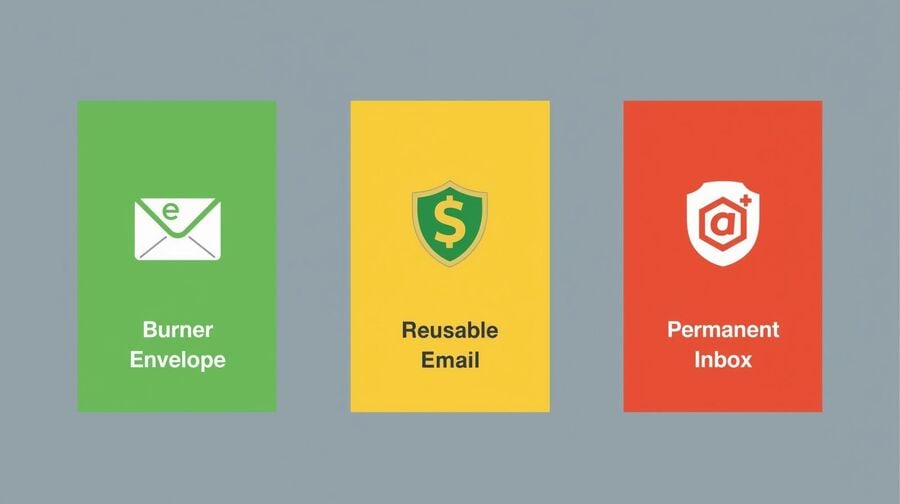
For practical planning, think in terms of three broad categories:
- Permanent email: a long-term inbox on Gmail, Outlook, or your own domain, protected with strong 2FA.
- Reusable temp mail: a generated address that you can reopen later using a token, such as the model described at reuse a temp mail address.
- Short-life temp mail: classic "burner" addresses meant to be used once and then forgotten.
Permanent email for high-value accounts
Permanent email is the only sensible choice for the top tier of your crypto stack:
- KYC'd spot and derivatives exchanges that connect to bank cards or wires.
- Custodial wallets and CeFi platforms that hold your keys or balances.
- Portfolio and tax tools that track long-term performance and reports.
These accounts should be treated like banking relationships. They need an email address that will still exist in five or ten years, not a disposable identity that might silently vanish.
Reusable temp inboxes for medium-risk tools
Reusable temp inboxes make sense for medium-risk platforms where you want separation from your primary identity, but you may need access again later:
- Trading analytics, research dashboards, and market-data tools.
- Bots, alerts, and automation services you are testing.
- Education portals and communities that do not hold your funds directly.
Here, you can accept that the address is semi-disposable as long as you store the Access Token in a password manager and document which tools depend on that inbox.
Burner inboxes for pure throwaways
Short-lived inboxes are ideal for sign-ups you genuinely do not plan to revisit:
- Low-value airdrops and giveaway forms with aggressive marketing.
- Promotional wheels, contests, and sign-up walls that look spammy.
- Testnet tools, where you are only experimenting with fake assets.
In these cases, if the email disappears later, you have not lost anything important, only some marketing noise and one-off perks.
When Temp Mail Is Acceptable
Use disposable addresses to absorb spam, experimentation, and low-stakes sign-ups, rather than securing the core of your portfolio.

Newsletters, alerts, and marketing funnels
Many exchanges, educators, and analytics vendors love sending frequent updates. Rather than letting this flood your primary inbox, you can route them to temp mail:
- Educational newsletters from trading communities.
- Product launches and "alpha" updates from research tools.
- Marketing sequences from exchanges you are only exploring.
This keeps phishing attempts and list-selling behavior at a safe distance from your more sensitive accounts. A similar pattern is used in e-commerce, where users separate checkout spam from serious financial communications. The same concept is explained in the e-commerce privacy playbook.
Airdrops, waitlists, and speculative sign-ups
Airdrop pages, speculative token projects, and hype-driven waitlists often prioritize building a list over establishing long-term trust. Using temp mail here:
- Protects your real inbox from relentless announcements.
- Makes it easier to walk away from projects that turn out weak.
- Helps you avoid linking low-quality projects to your primary identity.
If the value is low and the UX looks fragile, a disposable inbox is usually the safer option.
Testnet tools and sandboxes
In testnet environments, your primary asset is your time and learning, not the tokens. If a demo exchange or experimental dashboard never touches real funds, pairing it with a temp address is reasonable as long as you do not treat that account as a long-term asset later.
When Temp Mail Becomes Dangerous
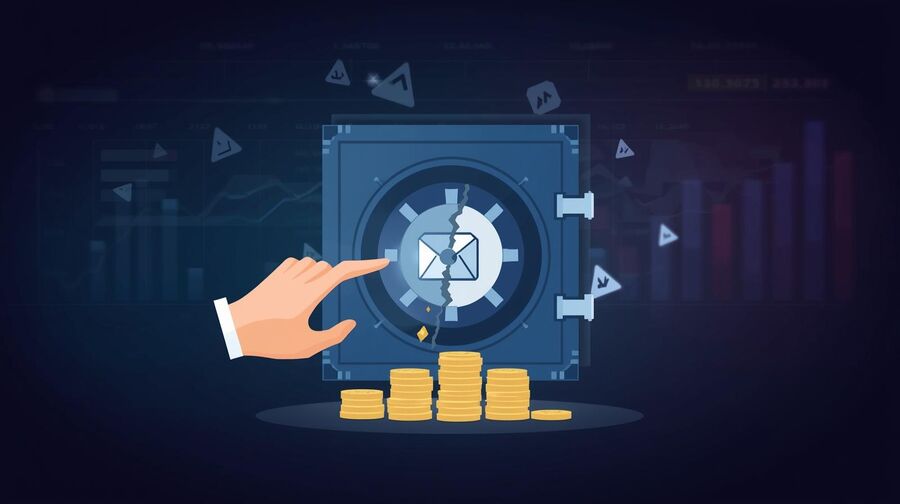
As soon as real money, KYC, or long-term trust is involved, disposable inboxes shift from a proper shield into a hidden liability.
KYC platforms and fiat bridges
KYC'd exchanges and fiat on-ramps operate under financial regulations similar to banks. They maintain compliance logs that tie email addresses to identity documents and transaction histories. Using a throwaway inbox here can:
- Complicate enhanced due-diligence reviews and manual investigations.
- Make it harder to prove long-term continuity of the account.
- Increase the likelihood that your case is treated as suspicious.
- Break a recovery or support flow outright if the platform later emails a statement or verification document as a file — because inbound attachments to a Tmailor address are stripped, and a message is only visible for about 24 hours.
You should not use temp mail to bypass KYC, hide from sanctions, or evade platform rules. That is both risky and, in many contexts, illegal. This is not a gray area the way "which domain gets through a signup form" is: an exchange account holds money and is bound to your verified identity, so it belongs on a permanent address, full stop.
Custodial wallets and long-term holdings
Custodial wallets and yield platforms consolidate meaningful value over time. They often rely on email for:
- Withdrawal confirmation links and security reviews.
- Notifications about policy changes or forced migrations.
- Critical security alerts about compromised credentials.
Pairing these services with short-life temp mail is like putting a bank vault behind a hotel room key and then checking out.
Non-custodial wallets that still use email
Non-custodial wallets put the seed phrase at the center, but many still use email for:
- Account portals and cloud backups.
- Device-linking or multi-device sync features.
- Vendor communication about critical security updates.
Even if your funds technically depend on the seed, weakening the surrounding security notifications with a disposable inbox is rarely worth the trade-off.
Build A Safer Crypto Inbox
A deliberate email architecture allows you to enjoy the benefits of temporary email addresses without compromising your ability to recover accounts.

Map your platforms by risk.
Start by listing all the crypto-related services you use: exchanges, wallets, portfolio trackers, bots, alerting tools, and education platforms. For each one, ask three questions:
- Can this platform move or freeze my funds?
- Is it tied to government ID or tax reporting?
- Would losing access pose a significant financial or legal issue?
Accounts that answer "yes" to any of these should use a permanent, well-secured email address. Medium-risk tools can be moved to reusable temporary inboxes. Only truly low-stakes sign-ups should use short-lived temporary inboxes.
Use reusable temporary email addresses where continuity matters.
Reusable temp inboxes shine when you need a balance between privacy and continuity. Instead of a one-time mailbox, you get an address that you can reopen with a token. That makes them ideal for:
- Crypto analytics and research services.
- Early-stage tools with limited but real value.
- Secondary community or education accounts.
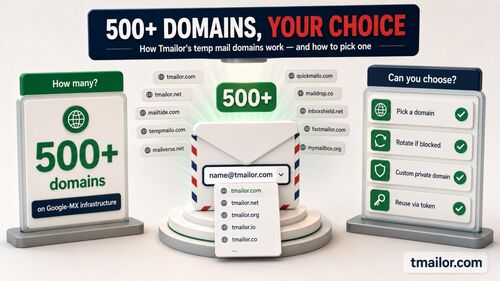
One mechanism detail is worth understanding here: a random address draws from a large, deliberately unpublished pool of domains, while the custom-name option exposes only a small visible set. You can read more about the temp mail domain pool. That variety is useful when one domain is having a delivery hiccup — but it is not a tool for slipping past a platform that has decided it does not accept disposable email. If a service clearly disallows temp mail, the answer is a permanent address, not a different domain.
Lean on infrastructure for OTP reliability.
OTP codes and login links are highly sensitive to delivery delays and blocking. Infrastructure matters here. When a temp mail provider uses reliable inbound servers and global CDNs, your odds of receiving codes on time improve significantly. If you want to go deeper into the technical side, see:
Good infrastructure does not eliminate every OTP problem, but it removes many of the random, hard-to-debug failures that plague weaker services.
Troubleshoot OTP And Deliverability
Before blaming the exchange, fix the basics: address accuracy, resend discipline, domain choice, and session timing.
When OTP emails do not arrive
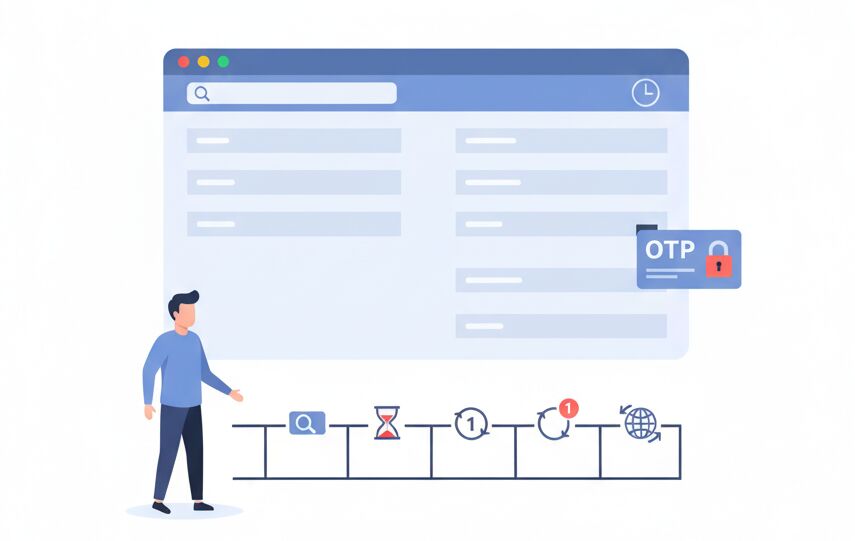
If you use temp mail and never see an OTP arrive, walk through a simple ladder:
- Double-check the exact address and domain you gave the platform.
- Open the inbox before clicking "Send Code" or "Login Link" — there is no spam folder, so the list you see is everything that arrived.
- Wait at least 60–120 seconds before requesting another code.
- Resend once or twice, then stop if nothing shows up.
- If the trouble looks limited to one domain and the platform has not clearly banned disposable email, test one fresh random address. If the service openly rejects temp mail, stop here and use a permanent email you control.
For a fuller breakdown of what makes OTP codes arrive or fail, it is worth reading the OTP verification with temp mail.
One retry beats a resend storm — for a one-domain glitch
Requesting five codes to the same address in two minutes tends to trip rate limits and can look more suspicious than sending one and waiting. If a single domain seems delayed while the platform otherwise accepts disposable email, one fresh random address is fair troubleshooting. Draw the line clearly, though: this is for a delivery hiccup, not a way around a service that has decided it won't take temp mail at all.
Know when to abandon temporary email addresses for that platform.
Persistence has limits. If you have run a careful resend cycle, tried one fresh address, and the platform still won't deliver OTPs to temporary inboxes, read that as the answer: it doesn't want disposable email. For any account you expect to keep — and certainly anything holding funds — switch to a permanent email sooner rather than later. Temp mail is a filter, not a crowbar.
Make A Long-Term Security Plan
A simple, written plan for your email stack makes your crypto footprint easier to defend and easier to recover.

Design a three-layer email stack.
A practical long-term setup looks like this:
- Layer 1 – Vault email: one permanent inbox for KYC'd exchanges, custodial wallets, tax tools, and anything that touches banking.
- Layer 2 – Project email: one or more reusable temp inboxes for analytics, bots, education, and emerging tools.
- Layer 3 – Burner email: short-life temp inboxes for airdrops, noisy promos, and one-off experiments.
This approach mirrors the separation used in privacy-first shopping flows, where disposable addresses handle noise without touching card details or tax records.
Store tokens and recovery clues safely
If you rely on reusable temp inboxes, treat each Access Token like a key:
- Save tokens and associated addresses in a password manager.
- Note which platform accounts depend on each address.
- Periodically review whether any temp-backed service has become "core."
When a platform moves from experimental to essential, migrate its contact email from a temp address to your vault inbox while you still have complete access.
Review your setup regularly.
Crypto stacks change. New tools emerge, old ones are shut down, and regulations evolve. Once a quarter, spend a few minutes checking:
- Whether all high-value accounts still point to a permanent email.
- Whether you can reopen every reusable temp inbox that matters.
- Which burner identities can be safely retired to reduce the attack surface?
This is also a good opportunity to revisit the general guardrails outlined in the main FAQ of the Ecommerce Privacy Playbook with Temporary Mail, which aligns neatly with financial and crypto use cases.
Comparison table
| Scenario / Feature | Short-Life Temp Inbox | Reusable Temp Inbox (Token-Based) | Permanent Personal / Work Email |
|---|---|---|---|
| Privacy from your real identity | Very high for one-off uses | High, with continuity over time | Moderate; strongest for trust and compliance |
| Long-term account recovery | Very poor; inbox may disappear | Good if the Access Token is stored safely | Strong; designed for multi-year continuity |
| Fit for KYC’d exchanges and fiat bridges | Unsafe and often blocked | Not recommended; risky for regulated platforms | Recommended; aligned with compliance expectations |
| Fit for custodial or high-value wallets | Very risky; avoid | Risky; acceptable only for small experimental funds | Recommended; default choice |
| Fit for testnet tools and demos | Good choice | Good choice | Overkill |
| Typical best use cases | Airdrops, low-value promos, testnet junk | Analytics tools, research dashboards, and communities | Core exchanges, serious wallets, tax, and reporting |
| Consequence if inbox is lost | Lose minor perks and noisy accounts | Lose access to some tools, but not core funds | Potentially severe if the entire footprint shares one |
How to Decide If Temp Mail Is Safe for a Crypto Sign-Up
Step 1: Identify the platform's fundamental role
Write down whether the service is an exchange, wallet, portfolio tracker, bot, research tool, or pure marketing funnel. Anything that can move or freeze funds automatically deserves more caution.
Step 2: Classify the risk level
Ask yourself what would happen if you lost access in two years. If you could lose significant money, break tax records, or face compliance issues, mark the platform as high risk. Otherwise, call it medium or low.
Step 3: Choose the matching email type
Use a permanent email for high-risk platforms, reusable temporary inboxes for medium-risk tools, and short-lived burners only for low-risk airdrops, promotions, and experiments that you genuinely do not need later.
Step 4: Check the platform's stance on temp mail
Scan the terms and error messages. If the platform explicitly rejects disposable domains or OTPs keep failing to arrive while your inbox works elsewhere, treat that as a sign to use a permanent address instead.
Step 5: Set up OTP and recovery hygiene
Before you request codes, open your inbox, then send one OTP and wait. If it does not arrive, follow a short resend-then-one-retry routine instead of hammering the button and stop if the platform clearly refuses temp mail. Store any Access Tokens or backup codes in your password manager.
Step 6: Document your choice for the future you
In a secure note, record the platform name, username, and email type you used. This tiny log makes it easier to communicate with support later, avoid duplication, and determine when it is time to migrate a growing account to your permanent inbox.
FAQ

Is it safe to open a main exchange account with a temporary email?
Generally, no. Any KYC'd exchange or fiat bridge that may hold real money over time should use a permanent inbox that you fully control, with strong two-factor authentication (2FA) and a clear recovery path.
Can I keep my trading account on a reusable temp inbox long-term?
You can, but it is not wise. If you ever lose the Access Token or the provider changes how access works, you may find it harder to pass security checks or prove continuity of ownership for that account. Remember too that a lost Access Token cannot be recovered by anyone.
When is a temporary email actually useful in cryptocurrency?
Temporary email shines on the edges: newsletters, airdrops, education funnels, and experimental tools that never handle serious funds. It keeps spam and lower-quality projects away from your primary identity.
Do crypto platforms block disposable email domains?
Some do. Acceptance varies by platform and can change without notice. If one specific domain fails but the platform does not appear to ban disposable email outright, testing one fresh random address is ordinary troubleshooting. If the service clearly rejects temp mail — which is common for KYC'd exchanges — use a permanent address instead of trying to cycle domains past the rule.
What if I've already created an important account using a temporary email?
Log in while you still have access to that inbox, then update the email to a permanent address. Confirm the change and store any new recovery codes in your password manager before you lose access to the old mailbox.
Is it okay to pair non-custodial wallets with a temporary email?
Your seed phrase still carries most of the risk, but email can handle updates and security alerts. For wallets you truly rely on, it is safer to use a permanent inbox and reserve temporary email addresses for peripheral accounts in your ecosystem.
How does tmailor.com help with OTP reliability compared to basic temp mail?
tmailor.com uses a large pool of domains, along with Google-MX infrastructure and CDN delivery, to enhance deliverability and speed for time-sensitive codes. That does not replace good user habits, but it removes many avoidable failures.
Should I use a temporary email address to avoid future KYC or tax audits?
No. Email tricks do not meaningfully hide on-chain activity, banking rails, or identity documents. Using unstable contact details can create friction without delivering real privacy benefits in regulated contexts.
What is the simplest email setup if I use many exchanges and tools?
A practical approach involves maintaining one permanent "vault" email for transactions that involve money, one or more reusable temporary inboxes for tools and communities, and short-lived burners for noisy, low-value sign-ups.
How often should I review which accounts use temporary email addresses?
Checking every three to six months is enough for most people. Look for any account that has become more important than you expected, and consider moving its contact email from a disposable inbox to your primary email address.
Temporary email and crypto can coexist safely, but only when you reserve disposable inboxes for low-stakes edges of your stack, keep serious money behind boring permanent addresses, and design a recovery path that does not depend on an inbox you plan to throw away.

Marcus Lee writes Tmailor's step-by-step guides — signing up to apps and platforms with temp mail, using the mobile app and Telegram bot, custom domains, reusing addresses, and getting the most out of disposable email day to day.