The Evolution of Temp Mail: How Disposable Email Became a Privacy Essential
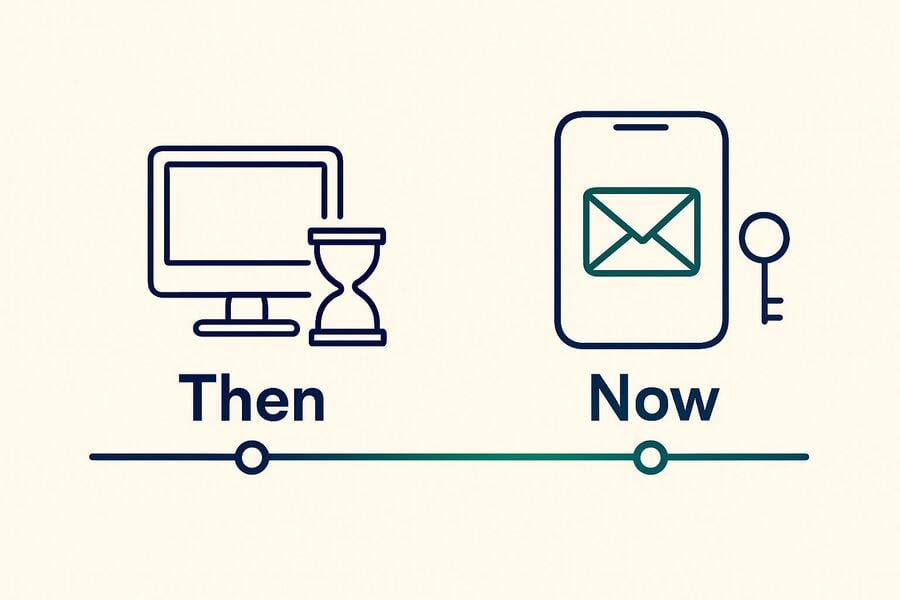
Temporary email was not originally intended as a privacy tool. The first temp mail services were simple workarounds — quick ways to dodge spam and access messages on public computers without committing to a permanent account. Over two decades, temp mail has evolved from a bare-bones throwaway inbox into a legitimate, multi-platform privacy layer used by millions of people every day. This guide traces the evolution of temporary email from the late 1990s to 2026.
Quick access
Key Takeaways
The major milestones that shaped temp mail from a niche internet hack into a mainstream privacy tool.
- The first disposable email services appeared in the late 1990s, designed for convenience on shared terminals — not privacy.
- The global spam epidemic of the early 2000s turned temporary email from a convenience tool into a defensive necessity.
- Timed inboxes (the 10 minute mail model) launched around 2006, making self-destructing email a mainstream concept.
- Domain rotation, catch-all routing, and token-based reuse solved the deliverability and blocking problems that plagued early temp mail.
- Privacy regulations like GDPR (2018) and CCPA (2020) validated the data-minimization principles behind disposable email.
- In 2026, modern temp mail providers like tmailor.com run on far more resilient infrastructure — a large rotating pool of domains, mobile apps, Telegram bots, and Access Token reuse — while staying receive-only.
- The next generation of temporary email will be shaped by AI-driven detection, decentralized identity tools, and the ongoing tension between surveillance and privacy rights.
The Late 1990s: Where Disposable Email Began
Temp mail started as a practical fix for public-computer users who needed an address for a single task and nothing more.
The first services that offered throwaway email addresses grew out of the internet's early commercial years, around the turn of the millennium. Web-based email was still relatively new — Hotmail launched in 1996, Yahoo Mail in 1997, and Gmail would not arrive until 2004. Creating a real email account required filling out lengthy forms, choosing security questions, and committing to an address you would maintain indefinitely.
For people using shared or public computers — at libraries, university labs, and internet cafes — that commitment was impractical. They needed a temporary email address to receive a single message, confirm a download, or register for a service they would never use again. Early disposable email filled exactly that gap: simple web pages that generated a working address, displayed incoming messages, and asked nothing from the user.
Mailinator, one of the most recognized early temp mail services, launched in 2003 with a radically simple model. You could pick any address @mailinator.com, and incoming messages appeared in a publicly accessible inbox. No registration, no password, no ownership. It worked for its intended purpose but carried obvious limitations: a single domain that quickly became the most blocked address suffix on the internet, and zero privacy between users who guessed each other's addresses.
The 2000s: Spam Turns Temp Mail Into A Shield
When unsolicited email reached 90 percent of global traffic, temporary email became a defensive tool, not just a convenience.
Through the mid-to-late 2000s, spam reached crisis proportions. By various industry estimates, junk mail came to account for the large majority of all email sent worldwide, with commonly cited figures at the peak approaching or exceeding 90 percent of global traffic. Every online form, every newsletter subscription, and every forum registration became a potential entry point for spam. Users who shared their real email addresses with unfamiliar websites paid for it with overflowing inboxes, phishing attempts, and credential-stuffing attacks fueled by leaked address databases.
This was the inflection point for temp mail. What had been a niche tool for public-terminal convenience became a practical shield for anyone who interacted regularly with the web. If you did not trust a website with your permanent address, you gave it a temporary email address instead. If that address got spammed, you simply abandoned it. The purpose of disposable email shifted from "I need a quick address" to "I need to protect myself."
Ironically, as mainstream providers like Gmail improved their spam filters after 2004, the case for temp mail grew stronger. Spam filters react after your address is already exposed. A temporary email prevents exposure from happening in the first place — a fundamentally stronger approach to inbox protection.
The 2006–2012 Era: Timed Inboxes Go Mainstream
Self-destructing email arrived with the 10 minute mail concept, making disposable inboxes accessible to everyday users.
Around 2006, a new model of temp mail appeared: the timed inbox. Services like 10 minute mail gave users an address that automatically expired after a fixed countdown. This was a significant design innovation. Instead of relying on users to manually abandon an address, the service enforced impermanence by default — the inbox and all messages simply ceased to exist when the timer expired.
The timed model resonated with mainstream users who did not consider themselves privacy-conscious but wanted a fast way to sign up for something without consequences. It lowered the barrier to adoption: no decisions to make, no tokens to save, no cleanup required. The temporary email address appeared, served its purpose, and vanished automatically. Services like tmailor.com later built on this concept by offering both timed inboxes and longer-retention alternatives to cover a wider range of use cases.
But the timer model also exposed new limitations. Delayed verification emails, multi-step sign-up flows, and re-verification prompts could all arrive after the inbox expired. Users who created accounts with a timed, temporary email found themselves locked out when they needed to reset their password days later. The timer was elegant but rigid — it could not adapt to the unpredictable reality of how platforms actually use email.
The 2012–2020 Era: Technical Breakthroughs
Domain rotation, catch-all routing, and token recovery transformed temp mail from unreliable novelty to a production-grade tool.
The most important technical innovations in temporary email infrastructure happened during this period. These were not flashy user-facing features — they were backend changes that dramatically improved reliability, deliverability, and real-world usability of temp mail.
Domain Rotation
Early temp mail services relied on a single domain or a handful of them. Once those domains landed on platform blocklists, the whole service became unreliable for verification emails and low-risk sign-ups. The response was domain rotation at scale — keeping a large inventory of receiving domains and changing which subset actively issues addresses. On tmailor.com, random generation draws from a wider unpublished pool, while the custom-name tab exposes only a few public domains. That can help when one specific domain is filtered, but it does not override a site's rules: if a service explicitly forbids disposable email, the right move is to use a regular inbox instead.
Catch-All Routing and Random Aliases
Instead of pre-creating specific mailboxes, modern temp mail providers use catch-all routing. Any address at a given domain is accepted and routed to a dynamic inbox. Combined with random alias generation, this made temporary email address creation feel instant and eliminated the risk of address collisions between users.
Token-Based Recovery
The introduction of Access Tokens solved the biggest complaint about timed inboxes: the inability to return. On services like tmailor.com, each temporary address comes with a unique reuse a temp mail address later, on any device. The token is a recovery key, not a password: it is how you get back in, and if you lose it, no one can recover it for you. It bridged the gap between the impermanence of disposable email and the practical need to revisit an inbox — for delayed codes, multi-step verifications, and password resets — though the messages themselves still expire on the usual short window.
Enterprise-Grade Infrastructure
Early temp mail ran on a small number of servers with limited throughput. The shift to more resilient receiving infrastructure — with Google MX handling inbound delivery for tmailor.com — improved delivery speed and uptime. What changed was not glamour but reliability: disposable inboxes stopped feeling experimental and started behaving like stable utilities. The technical architecture behind modern temp mail is far more mature than the one-page tools that came first.
The 2018–2022 Era: Privacy Regulation Validates Temp Mail
GDPR and CCPA created a legal and cultural environment that made disposable email a mainstream privacy practice.
The General Data Protection Regulation (GDPR) took effect in the EU in May 2018. The California Consumer Privacy Act (CCPA) followed in January 2020. Both regulations fundamentally changed how companies collect, store, and share personal data — including email addresses.
For temporary email, the timing was perfect. GDPR's core principle of data minimization — the idea that you should share only the personal data that is truly necessary — is exactly the principle that temp mail is built on. While neither GDPR nor CCPA specifically endorses disposable email, they helped normalize privacy tools that reduce routine data exposure. Temp mail fits that logic for low-risk tasks: on tmailor.com, the basic web inbox needs no sign-up and no account, and messages are typically visible for only about 24 hours before they are purged.
Post-GDPR, websites are required to obtain explicit consent before adding users to marketing lists. In practice, consent mechanisms often use dark patterns to maximize opt-ins. A temporary email address remains an effective workaround: by never giving a real address, you sidestep the consent question entirely and keep your primary inbox free from unwanted subscriptions.
Where Temp Mail Stands In 2026
Modern temporary email is a mature, multi-platform privacy tool used by individuals, developers, and enterprises worldwide.
Today's temp mail services look nothing like their late-1990s ancestors. On tmailor.com — the service that publishes this blog — the current product is a no-sign-up, receive-only inbox with a large rotating pool of domains, mobile apps for Android and iOS, a Telegram bot, remote images loaded through a proxy so senders do not see your IP address, Access Token reuse, and roughly 24-hour message visibility. The limits are part of the honest picture: it cannot send or reply, inbound attachments are stripped so files sent to the address cannot be opened, and a lost Access Token cannot be recovered by anyone.
The user base has expanded far beyond privacy enthusiasts. QA teams use a temporary email for automated sign-up testing. Shoppers use it to grab discount codes without inbox clutter. Travelers use it for newsletter previews. Freelancers use it to separate client inquiries from personal accounts. Students use it for research sign-ups. The tool has become normalized across scenarios that would have seemed unusual a decade ago. If you want to understand the full scope of what modern temp mail can do, the how temp mail works covers every aspect from address generation to auto-deletion.
The Ongoing Blocking Arms Race
As temp mail has grown, more sites have added domain filters and reputation checks at sign-up, and some score domains in real time before accepting an address. Acceptance varies from platform to platform and can change without warning. A large domain inventory can help when one specific domain is filtered locally, but it does not override a site's policy. Where a service clearly disallows disposable email, that is a rule to respect, not a technical hurdle to route around — use a regular inbox instead.
What Comes Next For Temporary Email
AI-powered filtering, decentralized identity, and growing surveillance pressure will define the next chapter of temp mail.
AI-Driven Detection and Filtering
Platforms are starting to use machine learning to flag disposable-email patterns beyond simple domain matching — weighing registration behavior, sender reputation, and timing signals. That does not turn temp mail into an evasion product, and the responsible answer is not an arms race. It is better routing, clearer guidance to users about what the tool is for, and a plain fallback: when a service deliberately disallows disposable email, use a real address.
Decentralized and Self-Hosted Options
The growing interest in self-sovereign identity may push temporary email toward services that run on user-controlled infrastructure. Features like tmailor.com's custom domain support already move in that direction, letting users route inbound mail for a domain they control into a receive-only temp inbox. That shifts the ownership and blocklist trade-off in the user's favor, but it does not guarantee that every site will accept the address.
Deeper Integration Into Privacy Stacks
Temp mail is increasingly viewed as one layer in a broader privacy toolkit alongside VPNs, password managers, and browser privacy tools. Future development will focus on tighter integration — disposable email generation built directly into browsers, operating systems, or password managers, reducing the friction of using a separate service.
Frequently Asked Questions
Common questions about the history, evolution, and future of temporary email and temp mail services.
When was the first temp mail service created?
Throwaway email grew out of the internet's early commercial years, around the turn of the millennium. Mailinator, one of the most well-known early temp mail providers, launched in 2003 with a public-inbox model that required no registration.
Why did temporary email become so popular?
The spam crisis of the 2000s was the primary driver. As unsolicited email grew to dominate global traffic — by various estimates approaching 90 percent at its peak — users needed a way to interact with websites without exposing their real addresses. Temp mail provided that protective layer.
What is domain rotation, and why does it matter for temp mail?
Domain rotation means a temp mail provider keeps a large inventory of domains and changes which subset actively issues addresses. It matters because one specific domain can be filtered or overused even while the service itself still works. On tmailor.com, random generation draws from a wider pool than the few domains exposed for custom names, but whether any address is accepted still depends on each site's policy.
How did GDPR affect the temp mail industry?
GDPR validated the core principle behind temporary email — data minimization. It created a legal and cultural environment where sharing less personal data became mainstream, increasing demand for privacy tools including temp mail services.
What is an Access Token in modern temp mail?
An Access Token is a unique recovery key that lets you reopen the same temporary address after closing your browser or switching devices. On tmailor.com, each generated address comes with one you can save. It is not a password and cannot be recovered if lost, and the messages inside still expire on the usual short window.
Is it legal to use temp mail?
Yes. Using temporary email is legal in the United States and most countries. It is a privacy tool comparable to a VPN or email alias. Using any email address to commit fraud or violate platform terms of service can create legal issues, but the tool itself is legal.
Will platforms eventually block all temporary email addresses?
Probably not in absolute terms, because email policies vary by service and can change without notice. What matters in practice is the individual site's rule: if one specific domain is filtered, a different address may work, but if the platform explicitly disallows disposable email, use a regular address for that account.
How is modern temp mail different from early disposable email?
Modern temp mail commonly adds multi-domain routing, mobile access, short retention windows, and some form of inbox reuse. On tmailor.com, the current mix is a large rotating domain pool, Android and iOS apps, a Telegram bot, roughly 24-hour message visibility, remote images loaded through a proxy, and Access Token reuse. Early services were usually single-domain pages with public inboxes and no recovery mechanism.
What role will AI play in the future of temp mail?
AI is showing up on both sides. Platforms use machine learning to flag disposable-email patterns beyond simple domain matching. On the provider side, the responsible use is not an arms race but better routing and clearer guidance about what a receive-only inbox is for — with the same plain fallback that a site's own policy always wins.
Can I use my own domain with a temp mail service like tmailor.com?
Yes. tmailor.com offers a custom domain feature that lets you route inbound mail for a domain you control into a temp inbox. It gives you more control over the address identity and can reduce your exposure to public disposable-domain blocklists, but acceptance still depends on each individual site's rules.
The Bottom Line
Temp mail evolved from a scrappy workaround into a privacy essential — and the forces driving that evolution are accelerating.
Temporary email is one of the internet's quiet success stories. It started as a hack for public-computer users, grew into a spam shield during the inbox crisis of the 2000s, matured through technical innovation in the 2010s, and gained mainstream legitimacy alongside the global privacy movement. Each era solved a specific problem: early services solved convenience, timed inboxes solved commitment anxiety, domain rotation solved deliverability, and token recovery solved the reuse gap. The result — exemplified by modern services like tmailor.com — is a temp mail tool that in 2026 works reliably across platforms, devices, and use cases its original creators never imagined. The next chapter will be defined by the tension between growing surveillance infrastructure and the enduring human need to interact online without being permanently identified.

Marcus Lee writes Tmailor's step-by-step guides — signing up to apps and platforms with temp mail, using the mobile app and Telegram bot, custom domains, reusing addresses, and getting the most out of disposable email day to day.