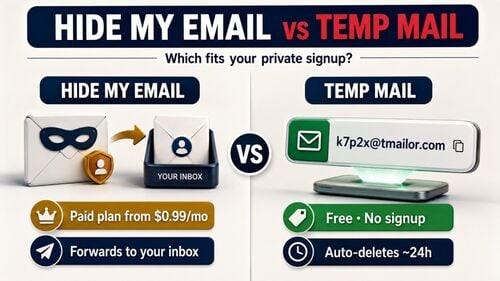
Unexpected Use Cases of Temp Mail You Never Thought Of
Most people associate temp mail with one thing: avoiding spam. But disposable email addresses are quietly useful in dozens of scenarios that have nothing to do with junk mail — from getting better prices on flights to running automated QA tests to keeping project and download signups out of your main inbox. This guide explores the unexpected, creative ways people use temporary email in their daily lives and work. Each use case is practical, legal, and immediately actionable. You'll probably recognize at least a few situations where you've been using your real email address out of habit — when a disposable one would have been faster, safer, and smarter.
Quick access
TL;DR / Key Takeaways
- Temp Mail has evolved into a privacy and productivity tool.
- People use it daily for coupons, reviews, events, and safer job searches.
- Marketers gain an edge in campaign QA, funnel testing, and competitor analysis.
- Developers integrate temp mail into CI/CD pipelines and AI environments.
- Businesses balance fraud prevention with customer privacy.
Introduction
Imagine walking into a store where every cashier demands your phone number before you can buy a bottle of water. That’s the internet today: nearly every site insists on an email. Over time, your inbox becomes a landfill of promotions, receipts, and spam you never requested.
Temp Mail, or disposable email, was born as a shield against this clutter. These days, it’s no longer just a trick to dodge newsletters. It has matured into a tool that marketers, developers, job seekers, and even event planners use. In many ways, it’s like a Swiss Army knife of digital privacy — compact, versatile, and unexpectedly powerful.
This article explores 12 use cases you probably never considered. Some are clever, some are practical, and a few might change how you think about email.
Section 1: Everyday Users
1. Smart Shopping & Coupons
Retailers often trade a one-time welcome code for your email address. A temporary inbox keeps that promo, the order confirmation, and any short-lived sale alert out of your main mailbox when the code is really all you wanted in the first place.
Beyond the single discount, some shoppers spin up a disposable inbox just to track seasonal sales across several stores. When the holiday rush ends, the inbox vanishes with the newsletters still in it — nothing to unsubscribe from later.
Treat it as a buffer for promotions, not a way to recycle the same first-order discount again and again — that is exactly the pattern stores watch for, and many forbid it outright.
2. Anonymous Reviews & Feedback
Reviews shape reputations. But what if you want to be brutally honest about a faulty gadget or a bad restaurant experience? Using your real email can invite unwanted follow-ups or even retaliation.
Temp Mail provides a way to speak freely. A one-time inbox lets you verify an account on a review site and leave honest, first-hand feedback without opening yourself to follow-up or retaliation. Share genuine experiences only, though — most review platforms forbid fake or incentivized posts, and a disposable inbox is not an exception to that.
3. Event Planning & RSVP Management
Organizing an event sets off a burst of one-time email: venue brochures, vendor quotes, webinar confirmations, wait-list notices. A dedicated temporary inbox keeps that short-lived traffic in one place while you compare options, and none of it follows you home—no “Happy anniversary deals” from the caterer three years later.
Just don’t make it the address everyone replies to. Because the inbox is receive-only and messages fade after about a day, move to a regular account the moment contracts, attachments, or ongoing back-and-forth are involved.
Used that way, temp mail is a staging inbox for the research phase—not the home of the event itself.
4. Job Search Privacy
Job boards often act like spam factories. When you upload your resume, recruiters you’ve never met flood your inbox. Temp Mail acts as a privacy filter for job seekers who want control.
Use it to browse listings, sign up for alerts, or download career guides. When you’re ready for serious applications, switch to your primary email. This way, you avoid drowning in irrelevant offers while catching genuine opportunities.
Section 2: Marketers
5. Competitor Intelligence
Curious how a competitor nurtures new customers? Marketers sign up to a rival’s public newsletter with a disposable address. Within days, they receive the full drip sequence, seasonal promotions, even loyalty perks — all material any subscriber gets.
Nothing here is hidden or off-limits; it’s the same funnel every prospect sees. The temporary address simply keeps a rival’s marketing out of your day-to-day inbox while you study it.
6. Campaign Testing
Mistakes in email automation are costly. A broken discount link in a welcome email can sink conversions. Marketers use temp mail inboxes for brand-new subscribers to walk through the customer journey.
With multiple addresses, they can test how messages render on different domains and providers. It’s quality assurance in real-world conditions, not just in a lab.
7. Audience Simulation
AI personalization promises tailored experiences, but testing it is tricky. Marketers now simulate multiple personas — a budget traveler vs a luxury explorer — each tied to a temp mail inbox.
By tracking how each persona is treated, teams uncover whether personalization works. It’s an affordable way to audit AI-driven campaigns without relying on expensive third-party testing.
Section 3: Developers
8. QA & App Testing
For developers, creating new accounts repeatedly is a time sink. QA teams testing sign-ups, password resets, and notifications need a steady stream of fresh inboxes. Temp Mail provides precisely that.
Instead of burning hours on dummy Gmail accounts, they spin up disposable addresses in seconds. This speeds up sprints and makes agile development smoother.
9. API Integrations
Where a temp mail provider offers an API, development teams can automate the tedious parts of signup testing. The value is speed and repeatability; the exact endpoints and limits differ from provider to provider, so build against the one you actually use:
- Create a fresh inbox for a test run.
- Trigger the sign-up or password-reset flow.
- Read the incoming verification message programmatically.
- Save the Access Token if the same inbox has to be reopened later.
With Tmailor, keep any such workflow inside its real limits: receive-only, inbound attachments stripped, and messages visible for about 24 hours.
10. AI Training & Sandbox Environments
AI chatbots need training data that looks real but isn’t risky. Feeding them disposable inboxes filled with newsletters, alerts, and promos provides safe, synthetic traffic.
This allows developers to stress-test algorithms while keeping real customer data out of harm’s way. It’s a bridge between privacy and innovation.
Section 4: Businesses & Security Teams
11. Fraud Prevention & Abuse Detection
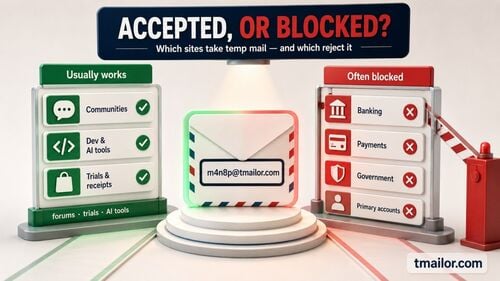
Not every use case is consumer-friendly, and it is worth naming the other side plainly. Businesses face real abuse from disposable addresses — fake sign-ups, free trial farming, and outright fraud — so security teams deploy filters to flag disposable domains. That is the legitimate reason a signup form sometimes rejects a temp address, and if a service has drawn that line, the answer is a real inbox, not a workaround.
Blocking every temp inbox is a blunt instrument, though. Sharper teams read behavioral signals — how fast accounts are created, from which IP ranges — to tell fraud apart from privacy-conscious users who simply prefer not to hand over a primary address.
12. Alias & Forwarding Control
Some temp mail services go beyond basics. Alias systems let users create unique addresses for each service. If one inbox gets sold or leaked, they know exactly who’s responsible.
Features like auto-expiration after a set number of messages add another control layer. It’s disposable email 2.0: privacy with accountability.
Case Study: From Funnels to Pipelines
Picture a marketing team about to put real budget behind a new campaign. Before a cent of paid traffic hits the funnel, they run the welcome flow with a handful of disposable inboxes — and catch the broken discount link and the promo code that never arrives — the quiet mistakes that cost conversions once the ads are live.
The same pattern helps developers in QA: create a fresh inbox, trigger the sign-up, confirm the verification message arrives, and save the Access Token only if that inbox has to be reopened later. No real accounts are exposed, and no test debris piles up behind the run.
The takeaway is simple: temp mail is a sharp tool for short-lived inbound checks, but it is not a stand-in for a real inbox when replies, attachments, or long-term records matter.
Conclusion
Temp Mail has grown from a spam-dodging hack into a versatile privacy and productivity tool. Today it supports shoppers chasing deals, marketers perfecting funnels, developers training AI, and businesses protecting platforms.
Like a spare key, you may not need it every day. But when you do, it can provide speed, safety, and peace of mind.
FAQ
1. Is Temp Mail safe for online shopping?
Yes. It’s great for short-term promotions or coupons. Avoid it for purchases requiring receipts or warranties.
2. How can marketers benefit without breaking compliance?
Use temp mail ethically for testing campaigns, monitoring competitors, and QA’ing automation flows. Always respect unsubscribe rules and data laws.
3. Can developers integrate Temp Mail into CI/CD?
Yes, where the provider offers an API. Typically you create an inbox, trigger the flow, and read the verification message programmatically. Supported endpoints and limits vary by provider, so build against the one you actually use.
4. Do businesses block disposable emails?
Some do, mainly to curb abuse. If a service clearly does not allow disposable email, use a regular inbox — working past a stated policy is not what temp mail is for. If only one domain is refused while the site otherwise accepts temp mail, another domain may deliver, but acceptance varies, and no disposable service is accepted everywhere.
5. What makes this service unique?
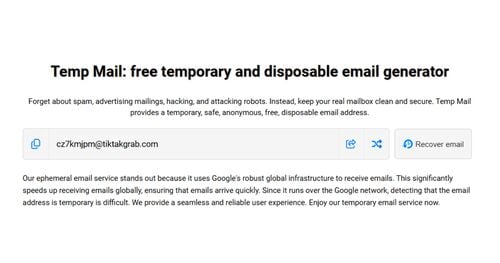
As a free temp mail service, it draws random addresses from a large, rotating pool of domains that receive mail over Google’s servers, shows incoming messages for about 24 hours, and works on the web, Android, iOS, and Telegram bot. Save the Access Token if you want to reopen the same address later — it is a recovery key, not a password, and a lost token cannot be restored.
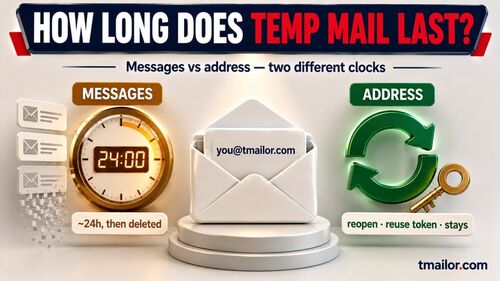
6. Are Temp Mail addresses permanent?
The address can persist, but messages fade after about 24 hours. Save the Access Token and you can reopen the same address later — though it will only ever show current mail, never the messages that have already expired.

Marcus Lee writes Tmailor's step-by-step guides — signing up to apps and platforms with temp mail, using the mobile app and Telegram bot, custom domains, reusing addresses, and getting the most out of disposable email day to day.