How to Create an Email Without a Phone Number: Private, No-SMS Options
Some providers ask for a phone number at signup, while others do not. This guide explains which email services still allow no-phone registration in 2026, when a temporary mailbox makes sense, and where the limits still are.
Quick access
Key Takeaways
You can create an email without a phone number, but the path depends on the provider. Privacy-first services like Proton Mail, Tuta, and Mailfence let you skip SMS by design, while Gmail and Outlook may still ask on riskier signups. For a throwaway address with no phone number, no name, and no registration, a temp mailbox is the fastest option.
- By-design no-phone providers. Proton Mail, Tuta, and Mailfence let you verify without a phone (via CAPTCHA, email, or nothing).
- Hard cases. Gmail is the toughest to sign up for without a phone; Outlook, GMX, and mail.com vary by region, IP, and risk signals.
- No-signup route. A temp mailbox needs no phone, no name, and no registration — ideal for signups and one-time codes.
- Privacy payoff. Leaving your phone off an inbox shrinks your exposure to SIM-swap attacks and data-broker linkage.
- Match the tool. Use a permanent no-phone inbox for accounts you keep; use a temp mailbox for quick, low-stakes verifications.
Why Create an Email Without a Phone Number?
Skipping the phone number at signup is a privacy decision, not a workaround. A phone number is a persistent, sensitive identifier, and tying it to a mailbox creates risks that have nothing to do with the email itself. Removing it narrows your exposure and keeps a single account from becoming a map to your whole identity.
- Fewer SIM-swap and SMS-hijack risks. If your number can recover your inbox, an attacker who ports or swaps your SIM can chase your accounts. Security agencies now treat SMS as a weak second factor for exactly this reason.
- Less data-broker linkage. Phone numbers are heavily used by ad-tech and data brokers to connect accounts across services. An inbox without one is harder to profile.
- Accessibility. Not everyone has a stable phone number, and no one should be locked out of email because of it.
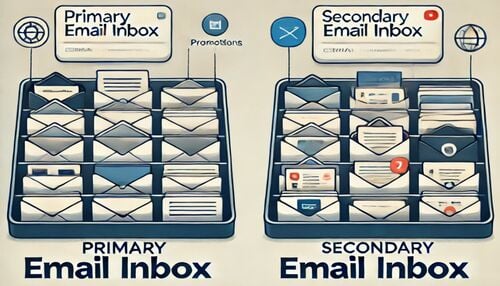
- Compartmentalization. Keeping a signup address separate from your identity limits the damage if that address ever leaks. If you are weighing the trade-offs, our explainer on how anonymous temp mail is covers what a no-account inbox does and does not hide.
Which Providers Let You Skip the Phone Number?
Not every service treats phone verification the same way. Privacy-first providers are built to work without a number, while mainstream providers ask for one whenever their anti-abuse systems get nervous. The table below sorts the common options by how reliably you can register without a phone in 2026.
| Provider | Phone at signup? | Notes |
|---|---|---|
| Proton Mail (free) | Not required | Human verification may use CAPTCHA, email, or SMS depending on context; phone is not mandatory |
| Tuta (free) | Not required | Anonymous signup; no mobile number required |
| Mailfence (free) | Not required | No phone number required; you do need an alternate email for password recovery |
| Temp mailbox | Never | No phone, no name, no registration; receive-only and disposable |
| GMX | Varies | Asks for a mobile number for password recovery, so it is not a reliable no-phone signup |
| mail.com | Varies | Lets you enter a phone number or an email address for password recovery |
| Outlook (Microsoft) | Varies | Phone prompts are region- and policy-dependent; no guaranteed no-phone path |
| Gmail (Google) | Varies | Signup is inconsistent and risk-driven; no guaranteed no-phone path |
The "varies" rows share one caveat: signup behavior at Gmail, Outlook, GMX, and mail.com is not fixed. Google explicitly says phone verification is sometimes required to help stop spammers, and GMX in particular asks for a mobile number during password recovery. The same form can skip the phone on one connection and ask for it on another, so treat these mainstream options as "maybe," not "guaranteed."
No-Phone Email Providers That Work by Design
Three privacy-first services are built for registration without a phone, which makes them the dependable choice for a permanent no-phone inbox. Each verifies you a different way, and none forces SMS.
Proton Mail
Proton Mail's free plan does not always require a phone number. Proton says human verification may use CAPTCHA, email, or SMS depending on the signup context, and its own no-phone signup guide shows CAPTCHA or email as the no-phone path. If you want one later, a recovery phone is optional rather than mandatory.
Tuta
Tuta (formerly Tutanota) positions itself as an anonymous, encrypted signup option with no mobile number required. That makes it a viable no-phone mailbox if you want a privacy-first alternative to mainstream providers, and it does not log IP addresses at signup.
Mailfence
Mailfence's free account asks only for a username, password, and an alternate email for password recovery — no phone. It is a conventional mailbox option with a lighter signup flow, so it fits if you want a normal inbox without the phone step.
The Fastest No-Phone Option: A Temp Mailbox
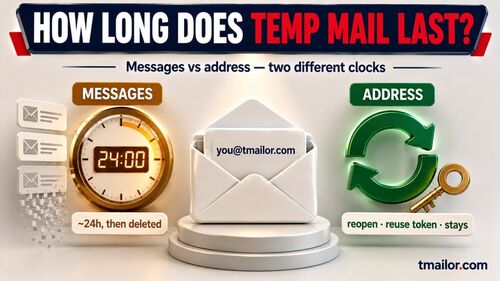
When you only need to receive a verification code or keep a signup off your real inbox, a temp mailbox is the quickest route. It asks for no phone, no name, and no registration at all, and it works in any browser. With Tmailor, an address is ready the moment you open the page, messages arrive through Google-MX infrastructure across 500+ domains, and the inbox auto-clears after about 24 hours.
The trade-off is that a temp mailbox is receive-only and disposable, not a permanent primary mailbox. It is built to receive verification codes and one-off confirmations, not to send mail or store history for years. If you are new to the idea, our overview of how temp mail works explains the model, and the guide on whether temporary emails are safe covers the privacy details. When you are ready, you can create a free temp mail and paste it straight into a signup form.
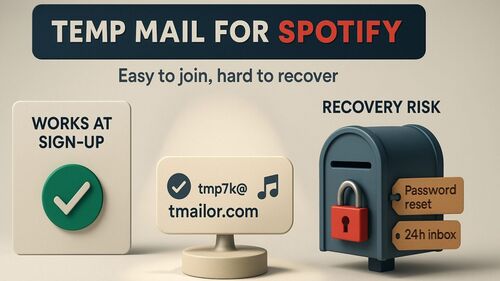
If you save an Access Token, you can reopen the same address later for a follow-up code or password reset. Store the token safely, because a lost Access Token cannot be recovered.
Permanent Inbox or Temp Mailbox: Which Should You Use?
The right no-phone option depends on how long you need the address to live. A permanent inbox suits accounts you will log into for months; a temp mailbox suits signups you want to keep at arm's length. Matching the tool to the task saves you both spam and hassle.
- Use a permanent no-phone inbox (Proton, Tuta, Mailfence) for a real second identity: a job search, a side project, or a mailbox you will actually send from.
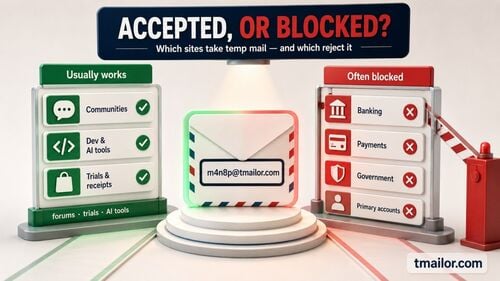
- Use a temp mailbox for free trials, forum registrations, downloads, and any site you are not sure you trust — anywhere a code is all you need.
- Use both together when you want a durable private inbox for the accounts that matter and a disposable one for everything else. If Gmail aliases tempt you as a shortcut, our comparison of temp mail versus email aliases explains why an alias still exposes your real address.
A Safer Alternative to SMS Verification
Leaving your phone off an inbox is also a chance to drop SMS as a security crutch. Standards bodies now rank text-message codes below app-based methods: NIST treats SMS one-time codes as a restricted authenticator and tells systems to watch for SIM changes and number porting, and U.S. cybersecurity guidance warns that SMS is exposed to SIM-swap attacks.
The practical upgrade is to prefer an authenticator app (a TOTP code) over SMS, and a passkey or hardware security key over both. Authenticator apps are not tied to your phone number, so they survive a SIM swap that would compromise SMS. Neither SMS nor an authenticator app is fully phishing-resistant — only passkeys and security keys reach that bar — but moving off SMS still closes the most common gap.
Limitations to Know
No single method covers every situation, so it helps to know where each one stops. A no-phone permanent inbox and a temp mailbox both have honest boundaries.
- Mainstream providers may still ask. Gmail and Outlook can demand a phone on flagged signups no matter what you try; there is no guaranteed no-phone path.
- Temp mail is receive-only. You can read incoming codes and links, but you cannot send mail or accept attachments from a temp address.
- Short retention. Temp inbox messages clear after about 24 hours, so copy anything you need and save your Access Token before it resets.
- Not for high-stakes accounts. Banks, government portals, and other strict services often block disposable domains and require a permanent, verified email — use a real inbox you control there.
Frequently Asked Questions
Common questions about registering an email without handing over a phone number.
Gmail without phone number: can you still sign up?
Sometimes, but Gmail is one of the least reliable mainstream providers for no-phone signup. Google says phone verification is sometimes required to help protect users and stop spammers, so there is no guaranteed no-phone path. If you want an email that doesn't require phone number verification, Proton Mail, Tuta, or Mailfence are more reliable bets.
Which email services don't require a phone number?
Proton Mail, Tuta, and Mailfence are built for registration without a phone, using CAPTCHA, email, or alternate recovery details instead of mandatory SMS. A temp mailbox goes further and needs no phone number, no name, and no registration, though it is disposable rather than a permanent mailbox.
Is it safe to use email without a phone number?
Yes, and it can be safer. Leaving your phone off an inbox reduces SIM-swap and data-broker exposure. Just secure the account another way: use a strong, unique password and an authenticator app rather than SMS for two-factor verification.
Does a temp mail address need a phone number?
No. A temp mailbox needs no phone, no name, and no registration. You open the page, get an address instantly, and use it to receive codes or confirmations. It is receive-only and clears after about 24 hours, so it suits signups rather than a permanent inbox.
Why do websites ask for a phone number at all?
Mostly for anti-abuse and account recovery. A phone number is harder to create in bulk than an email address, so services use it to slow down spam accounts. The downside for you is a persistent identifier tied to the account, which is exactly what a no-phone signup avoids.
SMS 2FA vs authenticator app: which is safer?
An authenticator app is safer. NIST and U.S. cybersecurity guidance rank SMS codes below app-based methods because a SIM swap or number port can intercept them. An authenticator app is not tied to your phone number, and a passkey or hardware key is stronger still. Prefer an app over SMS wherever a service allows it.
The Bottom Line
Creating an email without a phone number is realistic in 2026 — you just have to pick the right tool. Proton Mail, Tuta, and Mailfence are among the more reliable permanent options when you want to avoid mandatory phone verification, while Gmail and Outlook may still insist depending on how their systems read your signup. When you only need to catch a code or keep a signup off your real inbox, a temp mailbox is the fastest route: no phone number, no name, no registration, and no long-term inbox to manage.

Marcus Lee writes Tmailor's step-by-step guides — signing up to apps and platforms with temp mail, using the mobile app and Telegram bot, custom domains, reusing addresses, and getting the most out of disposable email day to day.